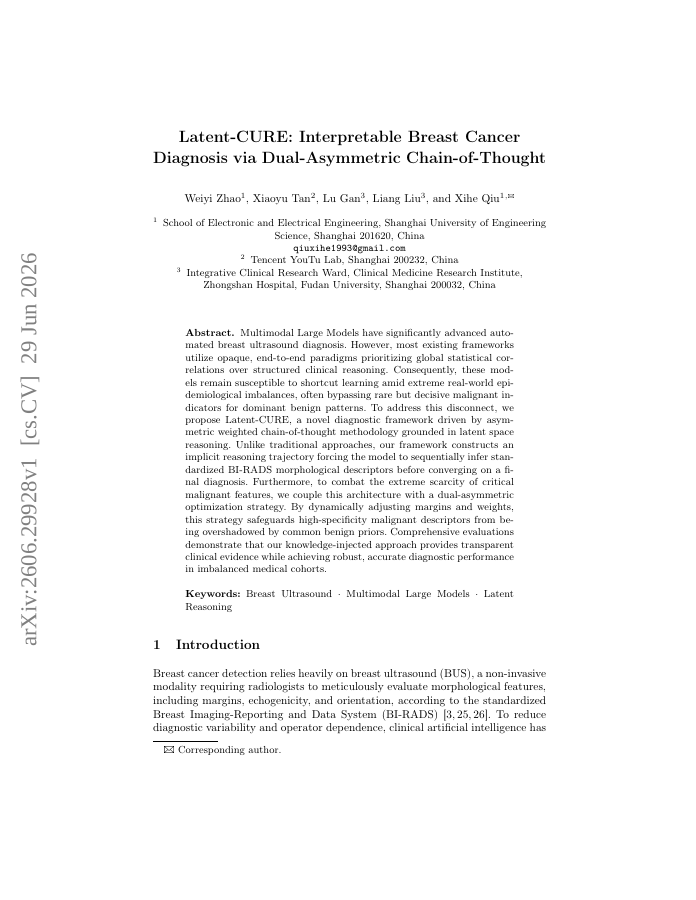
Multimodal Large Models have significantly advanced automated breast ultrasound diagnosis. However, most existing frameworks utilize opaque, end-to-end paradigms prioritizing global statistical correlations over structured clinical reasoning. Consequently, these models remain susceptible to shortcut learning amid extreme real-world epidemiological imbalances, often bypassing rare but decisive malignant indicators for dominant benign patterns. To address this disconnect, we propose Latent-CURE, a novel diagnostic framework driven by asymmetric weighted chain-of-thought methodology grounded in latent space reasoning. Unlike traditional approaches, our framework constructs an implicit reasoning trajectory forcing the model to sequentially infer standardized BI-RADS morphological descriptors before converging on a final diagnosis. Furthermore, to combat the extreme scarcity of critical malignant features, we couple this architecture with a dual-asymmetric optimization strategy. By dynamically adjusting margins and weights, this strategy safeguards high-specificity malignant descriptors from being overshadowed by common benign priors. Comprehensive evaluations demonstrate that our knowledge-injected approach provides transparent clinical evidence while achieving robust, accurate diagnostic performance in imbalanced medical cohorts.
Latent-CURE for Breast Cancer Diagnosis
Multimodal Large Models have significantly advanced automated breast ultrasound diagnosis. However, most existing frameworks utilize opaque, end-to-end paradigms prioritizing global statistical correlations over structured clinical reasoning.
- Preview
- Year
- 2026
- Hosting
- Abstract onlyARXIV-DEFAULT
Cite
Notes
Only stored in your browser.
Attribution
- Abstract & full text
- arxiv.org/abs/2606.29928ARXIV-DEFAULT
- TL;DR
- Semantic Scholar