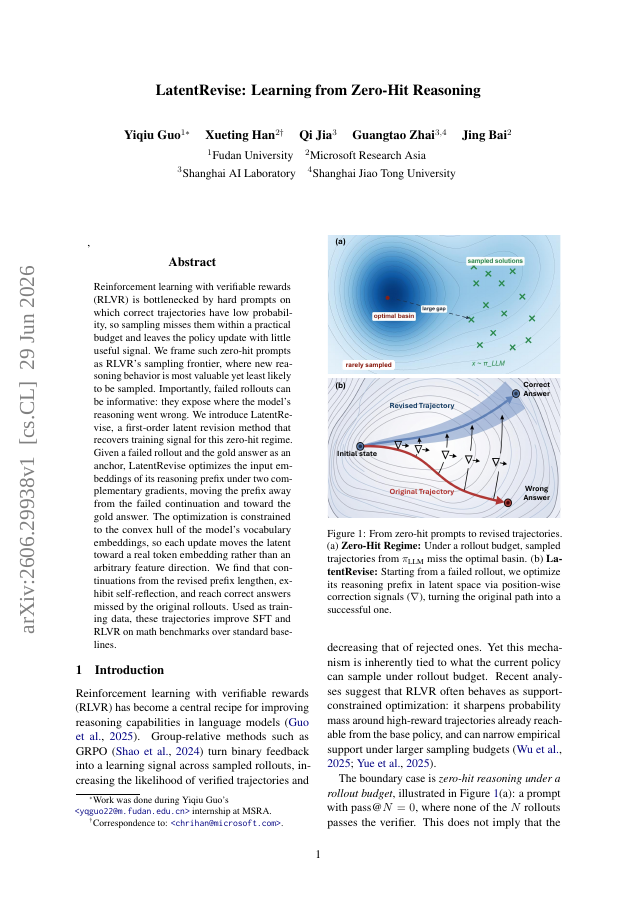
Reinforcement learning with verifiable rewards (RLVR) is bottlenecked by hard prompts on which correct trajectories have low probability, so sampling misses them within a practical budget and leaves the policy update with little useful signal. We frame such zero-hit prompts as RLVR's sampling frontier, where new reasoning behavior is most valuable yet least likely to be sampled. Importantly, failed rollouts can be informative: they expose where the model's reasoning went wrong. We introduce LatentRevise, a first-order latent revision method that recovers training signal for this zero-hit regime. Given a failed rollout and the gold answer as an anchor, LatentRevise optimizes the input embeddings of its reasoning prefix under two complementary gradients, moving the prefix away from the failed continuation and toward the gold answer. The optimization is constrained to the convex hull of the model's vocabulary embeddings, so each update moves the latent toward a real token embedding rather than an arbitrary feature direction. We find that continuations from the revised prefix lengthen, exhibit self-reflection, and reach correct answers missed by the original rollouts. Used as training data, these trajectories improve SFT and RLVR on math benchmarks over standard baselines.
LatentRevise: Learning from Zero-Hit Reasoning
Reinforcement learning with verifiable rewards (RLVR) is bottlenecked by hard prompts on which correct trajectories have low probability, so sampling misses them within a practical budget and leaves the policy update with little useful signal.
- Preview
- Year
- 2026
- Hosting
- Full text hostedCC-BY-4.0
Cite
Notes
Only stored in your browser.
Attribution
- Abstract & full text
- arxiv.org/abs/2606.29938CC-BY-4.0
- TL;DR
- Semantic Scholar