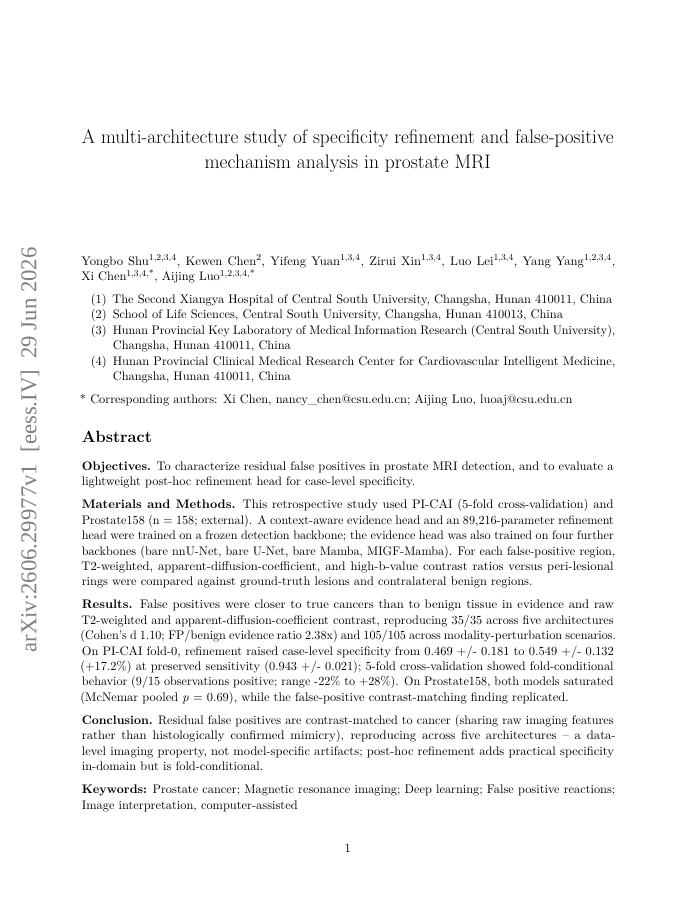
Objectives: To characterize residual false positives in prostate MRI detection, and to evaluate a lightweight post-hoc refinement head for case-level specificity. Materials and Methods: This retrospective study used PI-CAI (5-fold cross-validation) and Prostate158 (n=158; external). A context-aware evidence head and an 89,216-parameter refinement head were trained on a frozen detection backbone; the evidence head was also trained on four further backbones (bare nnU-Net, bare U-Net, bare Mamba, MIGF-Mamba). For each false-positive region, T2-weighted, apparent-diffusion-coefficient, and high-b-value contrast ratios versus peri-lesional rings were compared against ground-truth lesions and contralateral benign regions. Results: False positives were closer to true cancers than to benign tissue in evidence and raw T2-weighted and apparent-diffusion-coefficient contrast, reproducing 35/35 across five architectures (Cohen's d 1.10; FP/benign evidence ratio 2.38x) and 105/105 across modality-perturbation scenarios. On PI-CAI fold-0, refinement raised case-level specificity from 0.469 to 0.549 (+17.2%) at preserved sensitivity (0.943); 5-fold cross-validation showed fold-conditional behavior (9/15 observations positive; range -22% to +28%). On Prostate158, both models saturated (McNemar pooled p=0.69), while the false-positive contrast-matching finding replicated. Conclusion: Residual false positives are contrast-matched to cancer (sharing raw imaging features rather than histologically confirmed mimicry), reproducing across five architectures -- a data-level imaging property, not model-specific artifacts; post-hoc refinement adds practical specificity in-domain but is fold-conditional.
A multi-architecture study of specificity refinement and false-positive mechanism analysis in prostate MRI
Objectives: To characterize residual false positives in prostate MRI detection, and to evaluate a lightweight post-hoc refinement head for case-level specificity. Materials and Methods: This retrospective study used PI-CAI (5-fold cross-validation) and Prostate158 (n=158;…
- Preview
- Year
- 2026
- Hosting
- Full text hostedCC-BY-4.0
Cite
Notes
Only stored in your browser.
Attribution
- Abstract & full text
- arxiv.org/abs/2606.29977CC-BY-4.0
- TL;DR
- Semantic Scholar