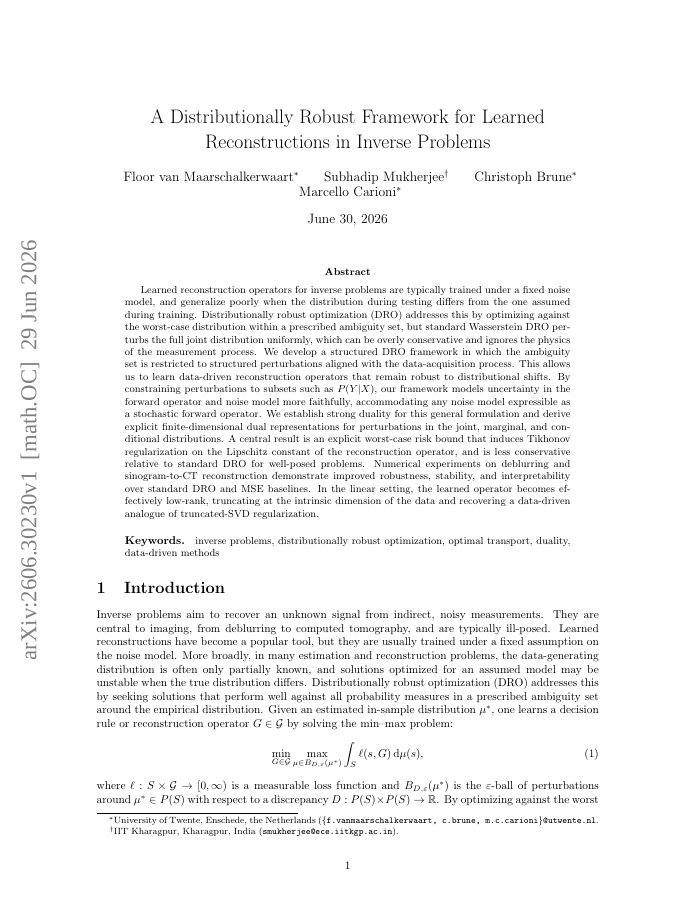
Learned reconstruction operators for inverse problems are typically trained under a fixed noise model, and generalize poorly when the distribution during testing differs from the one assumed during training. Distributionally robust optimization (DRO) addresses this by optimizing against the worst-case distribution within a prescribed ambiguity set, but standard Wasserstein DRO perturbs the full joint distribution uniformly, which can be overly conservative and ignores the physics of the measurement process. We develop a structured DRO framework in which the ambiguity set is restricted to structured perturbations aligned with the data-acquisition process. This allows us to learn data-driven reconstruction operators that remain robust to distributional shifts. By constraining perturbations to subsets such as P(Y|X), our framework models uncertainty in the forward operator and noise model more faithfully, accommodating any noise model expressible as a stochastic forward operator. We establish strong duality for this general formulation and derive explicit finite-dimensional dual representations for perturbations in the joint, marginal, and conditional distributions. A central result is an explicit worst-case risk bound that induces Tikhonov regularization on the Lipschitz constant of the reconstruction operator, and is less conservative relative to standard DRO for well-posed problems. Numerical experiments on deblurring and sinogram-to-CT reconstruction demonstrate improved robustness, stability, and interpretability over standard DRO and MSE baselines. In the linear setting, the learned operator becomes effectively low-rank, truncating at the intrinsic dimension of the data and recovering a data-driven analogue of truncated-SVD regularization.
A Distributionally Robust Framework for Learned Reconstructions in Inverse Problems
Learned reconstruction operators for inverse problems are typically trained under a fixed noise model, and generalize poorly when the distribution during testing differs from the one assumed during training.
- Preview
- Year
- 2026
- Hosting
- Full text hostedCC-BY-4.0
Cite
Notes
Only stored in your browser.
Attribution
- Abstract & full text
- arxiv.org/abs/2606.30230CC-BY-4.0
- TL;DR
- Semantic Scholar