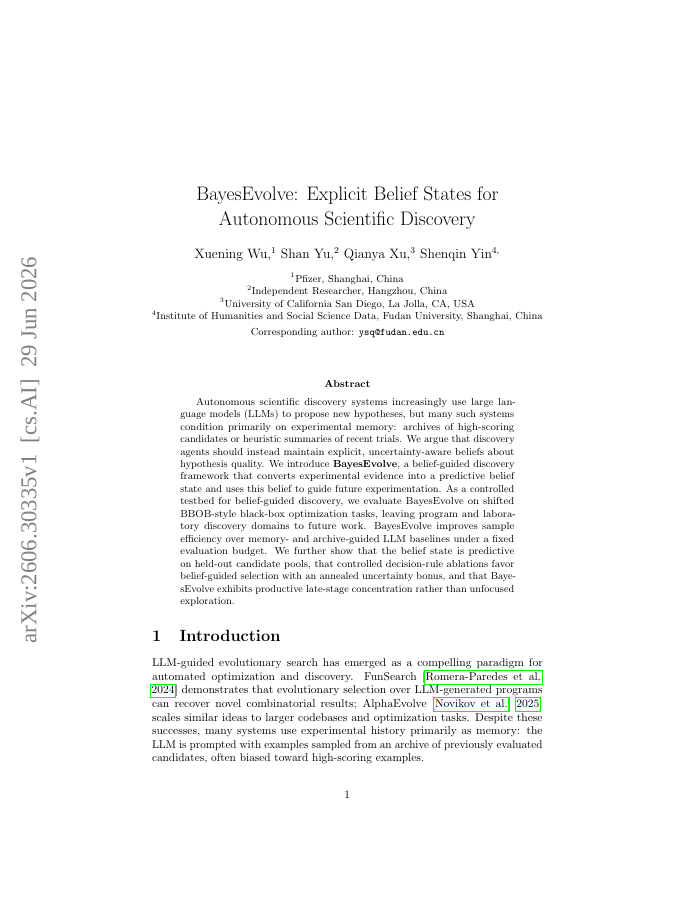
Autonomous scientific discovery systems increasingly use large language models (LLMs) to propose new hypotheses, but many such systems condition primarily on experimental memory: archives of high-scoring candidates or heuristic summaries of recent trials. We argue that discovery agents should instead maintain explicit, uncertainty-aware beliefs about hypothesis quality. We introduce BayesEvolve, a belief-guided discovery framework that converts experimental evidence into a predictive belief state and uses this belief to guide future experimentation. As a controlled testbed for belief-guided discovery, we evaluate BayesEvolve on shifted BBOB-style black-box optimization tasks, leaving program and laboratory discovery domains to future work. BayesEvolve improves sample efficiency over memory- and archive-guided LLM baselines under a fixed evaluation budget. We further show that the belief state is predictive on held-out candidate pools, that controlled decision-rule ablations favor belief-guided selection with an annealed uncertainty bonus, and that BayesEvolve exhibits productive late-stage concentration rather than unfocused exploration.
BayesEvolve: Explicit Belief States for Autonomous Scientific Discovery
Autonomous scientific discovery systems increasingly use large language models (LLMs) to propose new hypotheses, but many such systems condition primarily on experimental memory: archives of high-scoring candidates or heuristic summaries of recent trials.
- Preview
- Year
- 2026
- Hosting
- Full text hostedCC-BY-4.0
Cite
Notes
Only stored in your browser.
Attribution
- Abstract & full text
- arxiv.org/abs/2606.30335CC-BY-4.0
- TL;DR
- Semantic Scholar