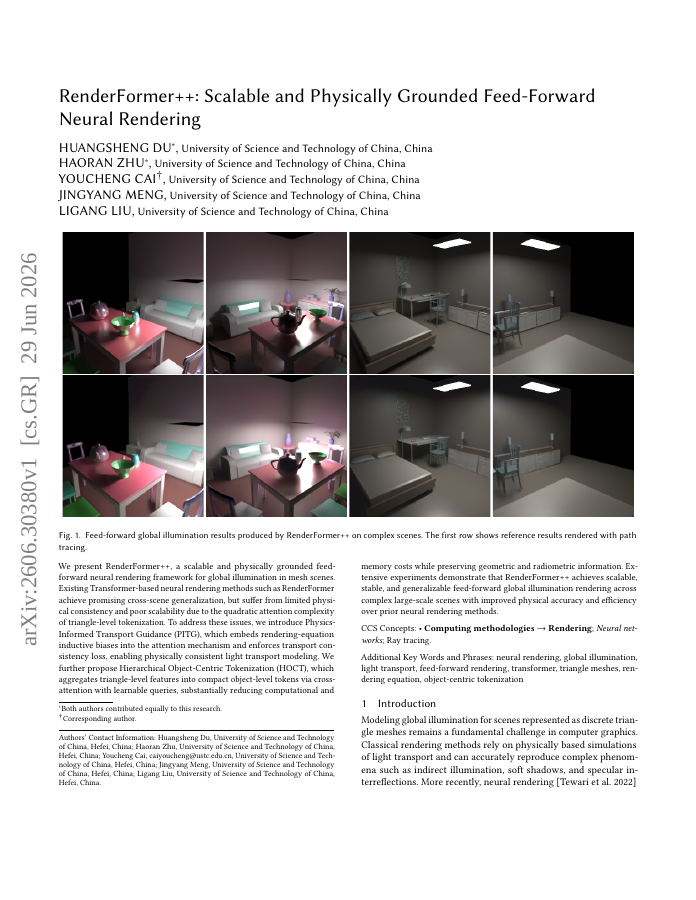
We present RenderFormer++, a scalable and physically grounded feed-forward neural rendering framework for global illumination in mesh scenes. Existing Transformer-based neural rendering methods such as RenderFormer achieve promising cross-scene generalization, but suffer from limited physical consistency and poor scalability due to the quadratic attention complexity of triangle-level tokenization. To address these issues, we introduce Physics-Informed Transport Guidance (PITG), which embeds rendering-equation inductive biases into the attention mechanism and enforces transport consistency loss, enabling physically consistent light transport modeling. We further propose Hierarchical Object-Centric Tokenization (HOCT), which aggregates triangle-level features into compact object-level tokens via cross-attention with learnable queries, substantially reducing computational and memory costs while preserving geometric and radiometric information. Extensive experiments demonstrate that RenderFormer++ achieves scalable, stable, and generalizable feed-forward global illumination rendering across complex large-scale scenes with improved physical accuracy and efficiency over prior neural rendering methods.
RenderFormer++: Scalable and Physically Grounded Feed-Forward Neural Rendering
We present RenderFormer++, a scalable and physically grounded feed-forward neural rendering framework for global illumination in mesh scenes. Existing Transformer-based neural rendering methods such as RenderFormer achieve promising cross-scene generalization, but suffer from…
- Preview
- Year
- 2026
- Hosting
- Abstract onlyARXIV-DEFAULT
Cite
Notes
Only stored in your browser.
Attribution
- Abstract & full text
- arxiv.org/abs/2606.30380ARXIV-DEFAULT
- TL;DR
- Semantic Scholar