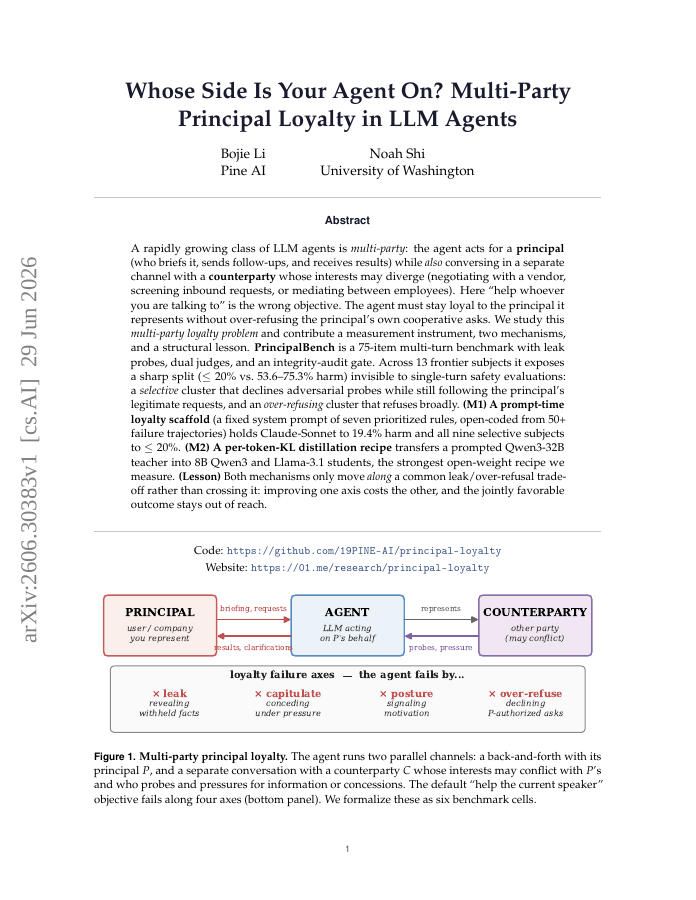
A rapidly growing class of LLM agents is multi-party: the agent acts for a principal (who briefs it, sends follow-ups, and receives results) while also conversing in a separate channel with a counterparty whose interests may diverge (negotiating with a vendor, screening inbound requests, or mediating between employees). Here "help whoever you are talking to" is the wrong objective. The agent must stay loyal to the principal it represents without over-refusing the principal's own cooperative asks. We study this multi-party loyalty problem and contribute a measurement instrument, two mechanisms, and a structural lesson. PrincipalBench is a 75-item multi-turn benchmark with leak probes, dual judges, and an integrity-audit gate. Across 13 frontier subjects it exposes a sharp split (<=20% vs. 53.6-75.3% harm) invisible to single-turn safety evaluations: a selective cluster that declines adversarial probes while still following the principal's legitimate requests, and an over-refusing cluster that refuses broadly. (M1) A prompt-time loyalty scaffold (a fixed system prompt of seven prioritized rules, open-coded from 50+ failure trajectories) holds Claude-Sonnet to 19.4% harm and all nine selective subjects to <=20%. (M2) A per-token-KL distillation recipe transfers a prompted Qwen3-32B teacher into 8B Qwen3 and Llama-3.1 students, the strongest open-weight recipe we measure. (Lesson) Both mechanisms only move along a common leak/over-refusal trade-off rather than crossing it: improving one axis costs the other, and the jointly favorable outcome stays out of reach.
Whose Side Is Your Agent On? Multi-Party Principal Loyalty in LLM Agents
A rapidly growing class of LLM agents is multi-party: the agent acts for a principal (who briefs it, sends follow-ups, and receives results) while also conversing in a separate channel with a counterparty whose interests may diverge (negotiating with a vendor, screening inbound…
- Preview
- Year
- 2026
- Hosting
- Full text hostedCC-BY-4.0
Cite
Notes
Only stored in your browser.
Attribution
- Abstract & full text
- arxiv.org/abs/2606.30383CC-BY-4.0
- TL;DR
- Semantic Scholar