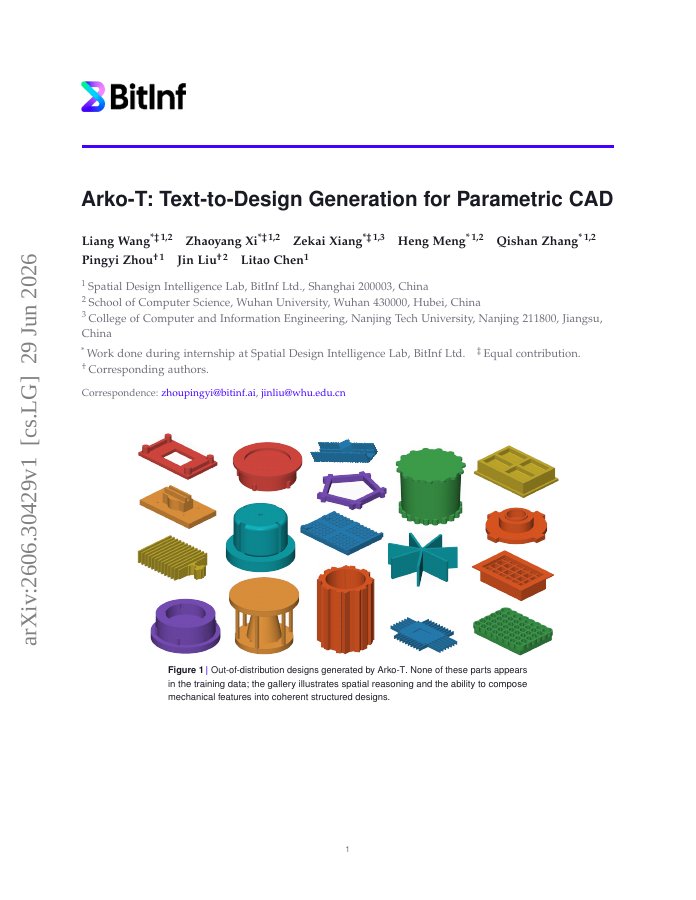
Text-to-3D systems can now synthesize a mechanical part from a single sentence, yet the result is a shape to render, not a design to edit. We present Arko-T, a 4B-parameter text-to-design model that maps natural-language intent directly into executable, parametric CAD programs. Rather than optimizing for code executability alone, Arko-T aligns every stage of the pipeline to a formal notion of design state, so that data curation, code normalization, and execution-grounded supervision all work to preserve the features, parameters, and construction logic that make a CAD artifact editable. Benchmarked against seven frontier LLMs across 12 metrics, Arko-T attains the best score on 8 and the second-best on 3 more, at roughly one-tenth the per-benchmark cost. The results suggest that targeted design-level training at moderate scale can match frontier general-purpose models on structured CAD generation.
Arko-T: A Foundation Model for Text-to-Structured 3D Generation
Text-to-3D systems can now synthesize a mechanical part from a single sentence, yet the result is a shape to render, not a design to edit. We present Arko-T, a 4B-parameter text-to-design model that maps natural-language intent directly into executable, parametric CAD programs.
- Preview
- Year
- 2026
- Hosting
- Full text hostedCC-BY-SA-4.0
Cite
Notes
Only stored in your browser.
Attribution
- Abstract & full text
- arxiv.org/abs/2606.30429CC-BY-SA-4.0
- TL;DR
- Semantic Scholar