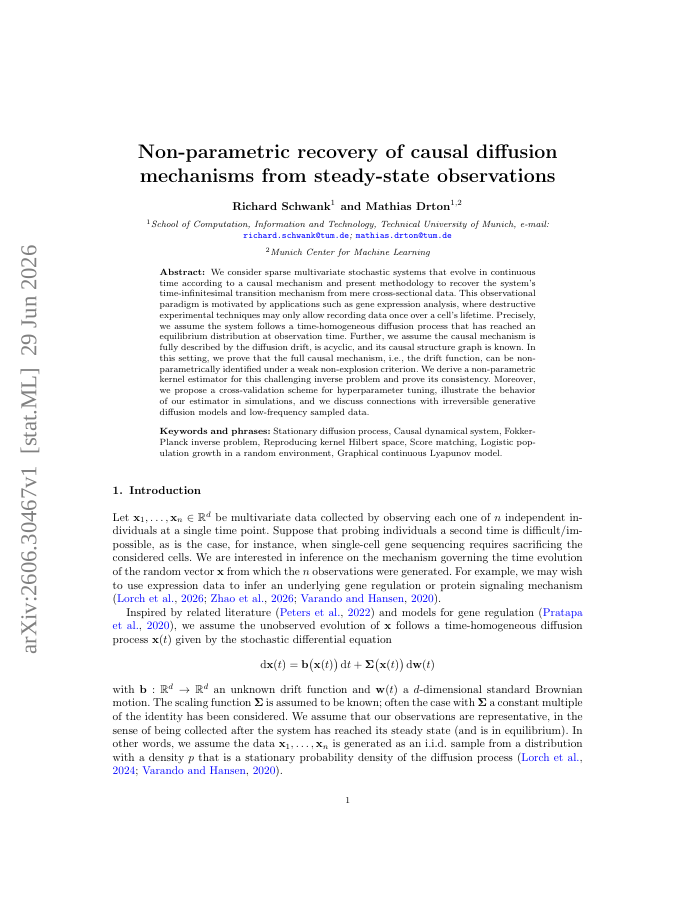
We consider sparse multivariate stochastic systems that evolve in continuous time according to a causal mechanism and present methodology to recover the system's time-infinitesimal transition mechanism from mere cross-sectional data. This observational paradigm is motivated by applications such as gene expression analysis, where destructive experimental techniques may only allow recording data once over a cell's lifetime. Precisely, we assume the system follows a time-homogeneous diffusion process that has reached an equilibrium distribution at observation time. Further, we assume the causal mechanism is fully described by the diffusion drift, is acyclic, and its causal structure graph is known. In this setting, we prove that the full causal mechanism, i.e., the drift function, can be non-parametrically identified under a weak non-explosion criterion. We derive a non-parametric kernel estimator for this challenging inverse problem and prove its consistency. Moreover, we propose a cross-validation scheme for hyperparameter tuning, illustrate the behavior of our estimator in simulations, and we discuss connections with irreversible generative diffusion models and low-frequency sampled data.
Non-parametric recovery of causal diffusion mechanisms from steady-state observations
We consider sparse multivariate stochastic systems that evolve in continuous time according to a causal mechanism and present methodology to recover the system's time-infinitesimal transition mechanism from mere cross-sectional data.
- Preview
- Year
- 2026
- Hosting
- Abstract onlyARXIV-DEFAULT
Cite
Notes
Only stored in your browser.
Attribution
- Abstract & full text
- arxiv.org/abs/2606.30467ARXIV-DEFAULT
- TL;DR
- Semantic Scholar