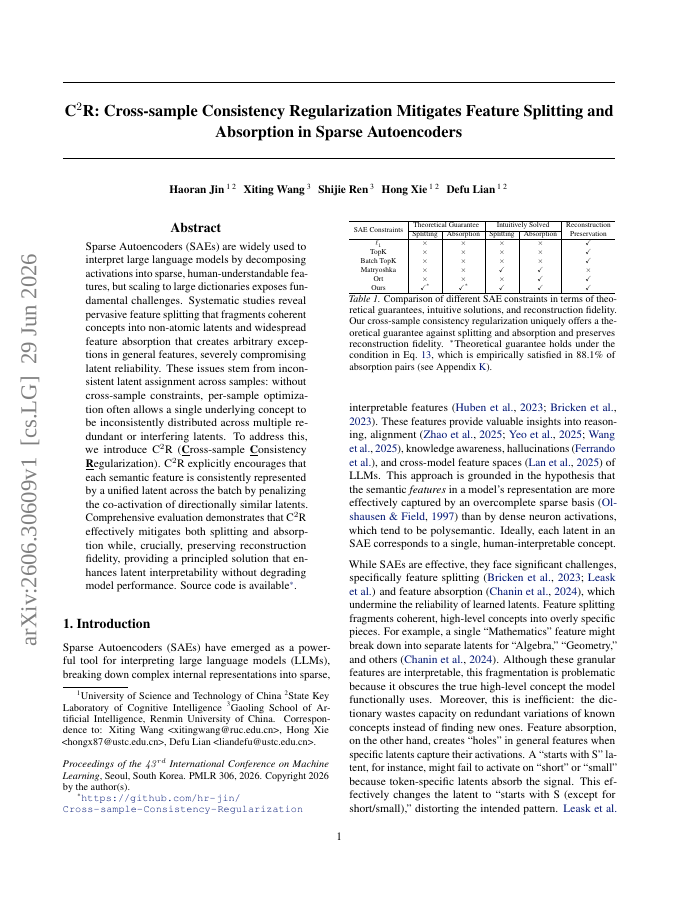
Sparse Autoencoders (SAEs) are widely used to interpret large language models by decomposing activations into sparse, human-understandable features, but scaling to large dictionaries exposes fundamental challenges. Systematic studies reveal pervasive feature splitting that fragments coherent concepts into non-atomic latents and widespread feature absorption that creates arbitrary exceptions in general features, severely compromising latent reliability. These issues stem from inconsistent latent assignment across samples: without cross-sample constraints, per-sample optimization often allows a single underlying concept to be inconsistently distributed across multiple redundant or interfering latents. To address this, we introduce C^2R (\underline{C}ross-sample \underline{C}onsistency \underline{R}egularization). C^2R explicitly encourages that each semantic feature is consistently represented by a unified latent across the batch by penalizing the co-activation of directionally similar latents. Comprehensive evaluation demonstrates that C^2R effectively mitigates both splitting and absorption while, crucially, preserving reconstruction fidelity, providing a principled solution that enhances latent interpretability without degrading model performance. Source code is available at https://github.com/hr-jin/Cross-sample-Consistency-Regularization.
C$^{2}$R: Cross-sample Consistency Regularization Mitigates Feature Splitting and Absorption in Sparse Autoencoders
Sparse Autoencoders (SAEs) are widely used to interpret large language models by decomposing activations into sparse, human-understandable features, but scaling to large dictionaries exposes fundamental challenges.
- Preview
- Year
- 2026
- Hosting
- Full text hostedCC-BY-4.0
Cite
Notes
Only stored in your browser.
Attribution
- Abstract & full text
- arxiv.org/abs/2606.30609CC-BY-4.0
- TL;DR
- Semantic Scholar