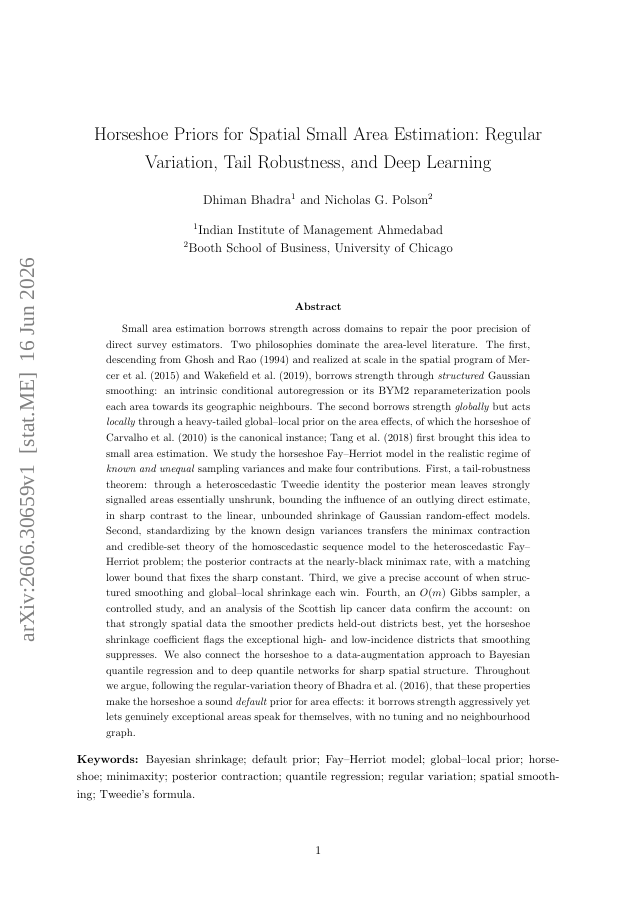
Small area estimation borrows strength across domains to repair the poor precision of direct survey estimators. Two philosophies dominate the area-level literature. The first, descending from Ghosh and Rao (1994), borrows strength through structured Gaussian smoothing: an intrinsic conditional autoregression or its BYM2 reparameterization pools each area towards its neighbours. The second borrows strength globally but acts locally through a heavy-tailed global-local prior on area effects, of which the horseshoe of Carvalho et al. (2010) is the canonical instance; Tang et al. (2018) first brought this idea to small area estimation. We study the horseshoe Fay-Herriot model with known unequal sampling variances and make four contributions. First, a tail-robustness theorem: through a heteroscedastic Tweedie identity the posterior mean leaves strongly signalled areas essentially unshrunk, bounding the influence of an outlying direct estimate, unlike Gaussian random-effect models. Second, standardizing by the known design variances transfers the minimax contraction and credible-set theory of the homoscedastic sequence model to the heteroscedastic Fay-Herriot problem; the posterior contracts at the nearly-black minimax rate, with a matching lower bound. Third, we give an account of when structured smoothing and global-local shrinkage each win. Fourth, an O(m) Gibbs sampler, simulations, and an analysis of the Scottish lip cancer data confirm the account: on strongly spatial data the smoother predicts held-out districts best, yet the horseshoe flags exceptional districts that smoothing suppresses. Throughout we argue, following the regular-variation theory of Bhadra et al. (2016), that these properties make the horseshoe a sound default prior for area effects: it borrows strength aggressively yet lets genuinely exceptional areas speak for themselves, with no tuning and no neighbourhood graph.
Horseshoe Priors for Spatial Small Area Estimation: Regular Variation, Tail Robustness, and Deep Learning
Small area estimation borrows strength across domains to repair the poor precision of direct survey estimators. Two philosophies dominate the area-level literature. The first, descending from Ghosh and Rao (1994), borrows strength through structured Gaussian smoothing: an…
- Preview
- Year
- 2026
- Hosting
- Full text hostedCC-BY-4.0
Cite
Notes
Only stored in your browser.
Attribution
- Abstract & full text
- arxiv.org/abs/2606.30659CC-BY-4.0
- TL;DR
- Semantic Scholar