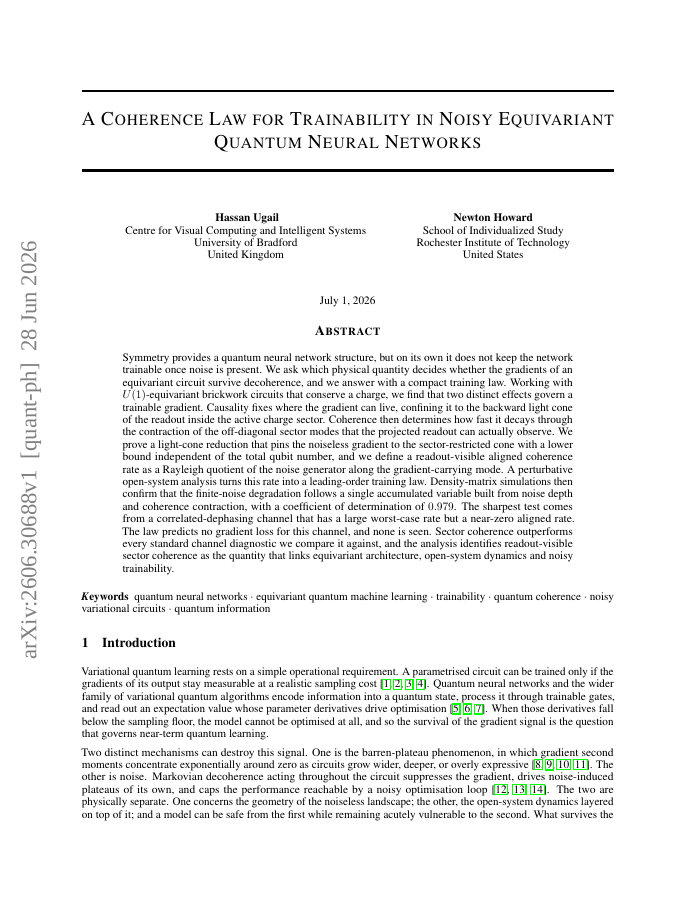
Symmetry provides a quantum neural network structure, but on its own it does not keep the network trainable once noise is present. We ask which physical quantity decides whether the gradients of an equivariant circuit survive decoherence, and we answer with a compact training law. Working with U(1)-equivariant brickwork circuits that conserve a charge, we find that two distinct effects govern a trainable gradient. Causality fixes where the gradient can live, confining it to the backward light cone of the readout inside the active charge sector. Coherence then determines how fast it decays through the contraction of the off-diagonal sector modes that the projected readout can actually observe. We prove a light-cone reduction that pins the noiseless gradient to the sector-restricted cone with a lower bound independent of the total qubit number, and we define a readout-visible aligned coherence rate as a Rayleigh quotient of the noise generator along the gradient-carrying mode. A perturbative open-system analysis turns this rate into a leading-order training law. Density-matrix simulations then confirm that the finite-noise degradation follows a single accumulated variable built from noise depth and coherence contraction, with a coefficient of determination of 0.979. The sharpest test comes from a correlated-dephasing channel that has a large worst-case rate but a near-zero aligned rate. The law predicts no gradient loss for this channel, and none is seen. Sector coherence outperforms every standard channel diagnostic we compare it against, and the analysis identifies readout-visible sector coherence as the quantity that links equivariant architecture, open-system dynamics and noisy trainability.
A Coherence Law for Trainability in Noisy Equivariant Quantum Neural Networks
Symmetry provides a quantum neural network structure, but on its own it does not keep the network trainable once noise is present. We ask which physical quantity decides whether the gradients of an equivariant circuit survive decoherence, and we answer with a compact training…
- Preview
- Year
- 2026
- Hosting
- Full text hostedCC-BY-4.0
Cite
Notes
Only stored in your browser.
Attribution
- Abstract & full text
- arxiv.org/abs/2606.30688CC-BY-4.0
- TL;DR
- Semantic Scholar