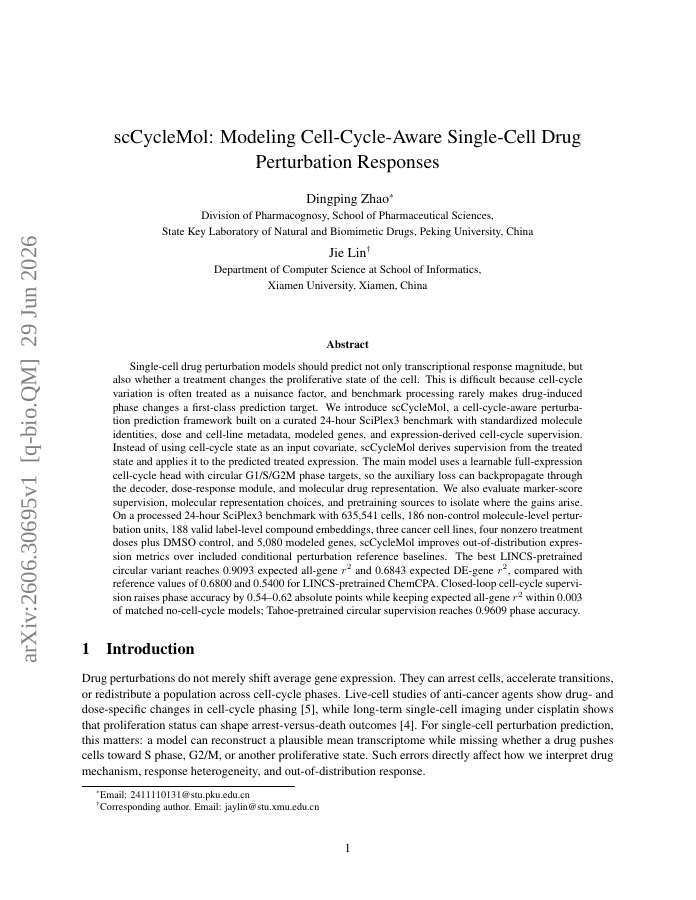
Single-cell drug perturbation models should predict not only transcriptional response magnitude, but also whether a treatment alters the proliferative state of a cell. This is challenging because cell-cycle variation is often treated as nuisance variation, and benchmark pipelines rarely treat drug-induced phase changes as a primary prediction target. We introduce scCycleMol, a cell-cycle-aware perturbation prediction framework built on a curated 24-hour SciPlex3 benchmark with standardized molecule identities, dose and cell-line metadata, and gene expression with cell-cycle supervision derived from treated states. Instead of using cell-cycle state as an input covariate, scCycleMol derives supervision from predicted treated expression and propagates it through a learnable full-expression cell-cycle head with circular G1/S/G2M phase targets. We evaluate marker-based supervision, molecular representations, and pretraining strategies to isolate sources of improvement. Across a SciPlex3 benchmark with over 600k cells, 186 perturbation conditions, multiple cancer cell lines, and thousands of genes, scCycleMol improves out-of-distribution expression prediction compared with conditional perturbation baselines. The best LINCS-pretrained circular model achieves 0.9093 expected all-gene r squared and 0.6843 expected differentially expressed gene r squared, compared with 0.6800 and 0.5400 for LINCS-pretrained ChemCPA. Closed-loop cell-cycle supervision improves phase accuracy by about 0.5 to 0.6 points while maintaining nearly unchanged expression prediction. A Tahoe-pretrained variant reaches 0.9609 phase accuracy, highlighting the benefit of explicit cell-cycle-aware supervision in perturbation modeling.
Modeling Cell-Cycle-Aware Single-Cell Drug Perturbation Responses
Single-cell drug perturbation models should predict not only transcriptional response magnitude, but also whether a treatment alters the proliferative state of a cell. This is challenging because cell-cycle variation is often treated as nuisance variation, and benchmark…
- Preview
- Year
- 2026
- Hosting
- Excerpt onlyCC-BY-NC-4.0
Cite
Notes
Only stored in your browser.
Attribution
- Abstract & full text
- arxiv.org/abs/2606.30695CC-BY-NC-4.0
- TL;DR
- Semantic Scholar