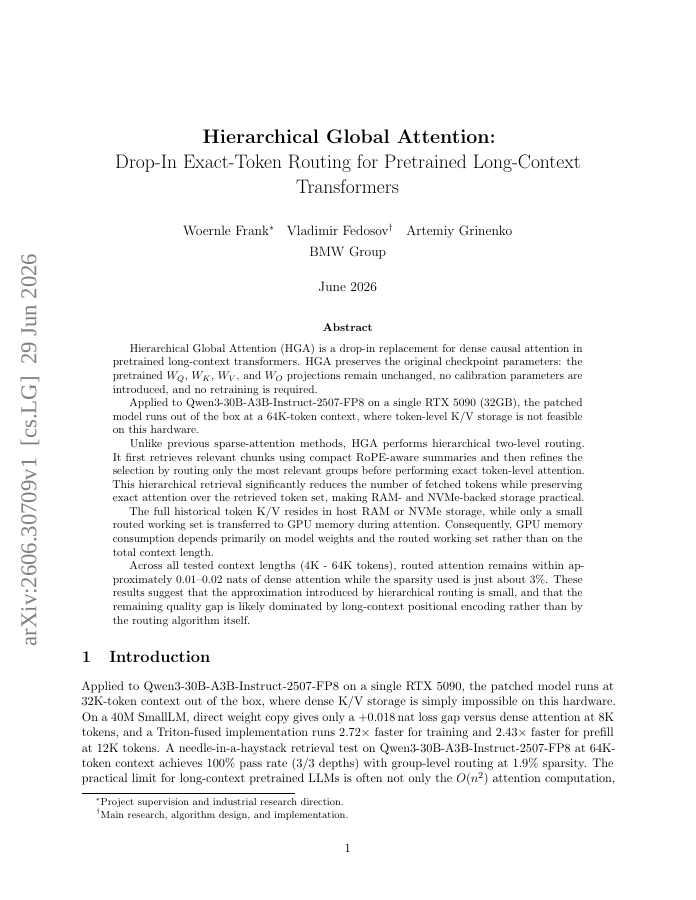
Hierarchical Global Attention (HGA) is a drop-in replacement for dense causal attention in pretrained long-context transformers. HGA preserves the original checkpoint parameters: the pretrained W_Q, W_K, W_V, and W_O projections remain unchanged, no calibration parameters are introduced, and no retraining is required. Applied to Qwen3-30B-A3B-Instruct-2507-FP8 on a single RTX 5090 (32GB), the patched model runs out of the box at a 64K-token context, where token-level K/V storage is not feasible on this hardware. Unlike previous sparse-attention methods, HGA performs hierarchical two-level routing. It first retrieves relevant chunks using compact RoPE-aware summaries and then refines the selection by routing only the most relevant groups before performing exact token-level attention. This hierarchical retrieval significantly reduces the number of fetched tokens while preserving exact attention over the retrieved token set, making RAM- and NVMe-backed storage practical. The full historical token K/V resides in host RAM or NVMe storage, while only a small routed working set is transferred to GPU memory during attention. Consequently, GPU memory consumption depends primarily on model weights and the routed working set rather than on the total context length. Across all tested context lengths (4K - 64K tokens), routed attention remains within approximately 0.01--0.02 nats of dense attention while the sparsity used is just about 3%. These results suggest that the approximation introduced by hierarchical routing is small, and that the remaining quality gap is likely dominated by long-context positional encoding rather than by the routing algorithm itself.
Hierarchical Global Attention (HGA)
Hierarchical Global Attention (HGA) is a drop-in replacement for dense causal attention in pretrained long-context transformers. HGA preserves the original checkpoint parameters: the pretrained $W_Q$, $W_K$, $W_V$, and $W_O$ projections remain unchanged, no calibration…
- Preview
- Year
- 2026
- Hosting
- Full text hostedCC-BY-4.0
Cite
Notes
Only stored in your browser.
Attribution
- Abstract & full text
- arxiv.org/abs/2606.30709CC-BY-4.0
- TL;DR
- Semantic Scholar