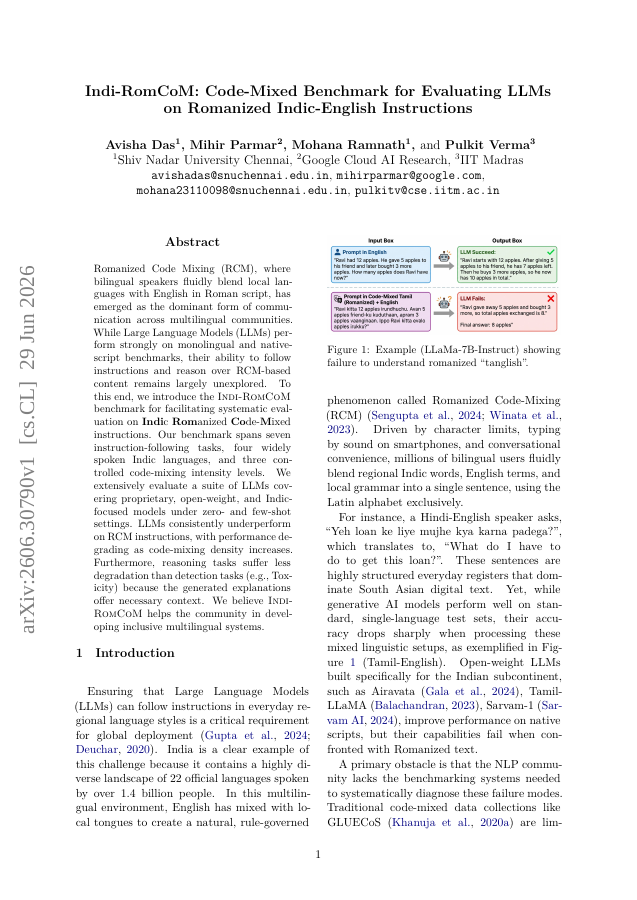
Romanized Code Mixing (RCM), where bilingual speakers fluidly blend local languages with English in Roman script, has emerged as the dominant form of communication across multilingual communities. While Large Language Models (LLMs) perform strongly on monolingual and native-script benchmarks, their ability to follow instructions and reason over RCM-based content remains largely unexplored. To this end, we introduce the Indi-RomCoM benchmark for facilitating systematic evaluation on Indic Romanized Code-Mixed instructions. Our benchmark spans seven instruction-following tasks, four widely spoken Indic languages, and three controlled code-mixing intensity levels. We extensively evaluate a suite of LLMs covering proprietary, open-weight, and Indic-focused models under zero- and few-shot settings. LLMs consistently underperform on RCM instructions, with performance degrading as code-mixing density increases. Furthermore, reasoning tasks suffer less degradation than detection tasks (e.g., Toxicity) because the generated explanations offer necessary context. We believe Indi-RomCoM helps the community in developing inclusive multilingual systems.
Indi-RomCoM: Code-Mixed Benchmark for Evaluating LLMs on Romanized Indic-English Instructions
Romanized Code Mixing (RCM), where bilingual speakers fluidly blend local languages with English in Roman script, has emerged as the dominant form of communication across multilingual communities.
- Preview
- Year
- 2026
- Hosting
- Abstract onlyARXIV-DEFAULT
Cite
Notes
Only stored in your browser.
Attribution
- Abstract & full text
- arxiv.org/abs/2606.30790ARXIV-DEFAULT
- TL;DR
- Semantic Scholar