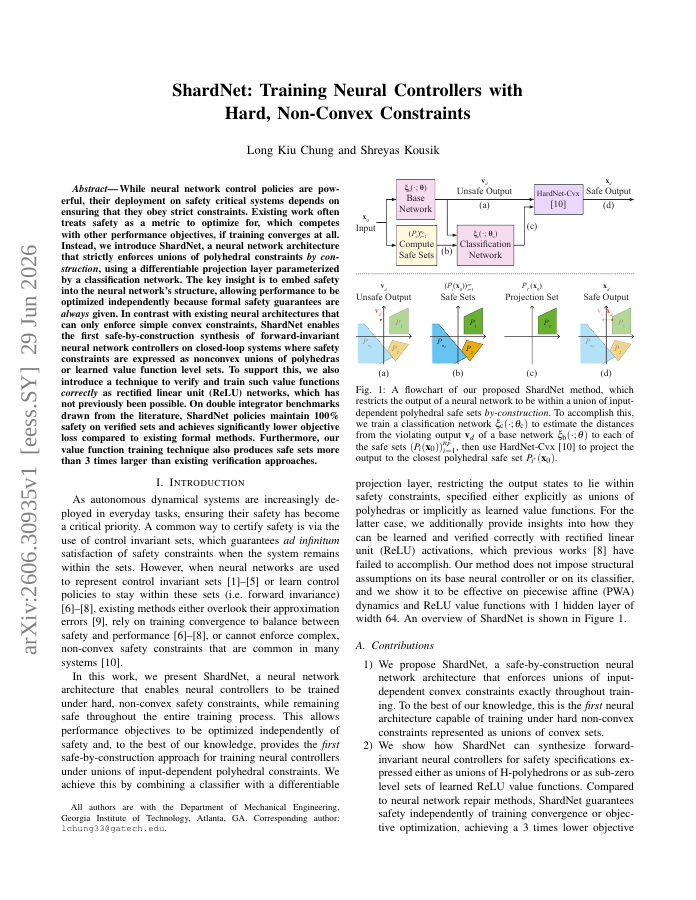
While neural network control policies are powerful, their deployment on safety critical systems depends on ensuring that they obey strict constraints. Existing work often treats safety as a metric to optimize for, which competes with other performance objectives, if training converges at all. Instead, we introduce ShardNet, a neural network architecture that strictly enforces unions of polyhedral constraints by construction, using a differentiable projection layer parameterized by a classification network. The key insight is to embed safety into the neural network's structure, allowing performance to be optimized independently because formal safety guarantees are always given. In contrast with existing neural architectures that can only enforce simple convex constraints, ShardNet enables the first safe-by-construction synthesis of forward-invariant neural network controllers on closed-loop systems where safety constraints are expressed as nonconvex unions of polyhedras or learned value function level sets. To support this, we also introduce a technique to verify and train such value functions correctly as rectified linear unit (ReLU) networks, which has not previously been possible. On double integrator benchmarks drawn from the literature, ShardNet policies maintain 100% safety on verified sets and achieves significantly lower objective loss compared to existing formal methods. Furthermore, our value function training technique also produces safe sets more than 3 times larger than existing verification approaches.
ShardNet: Training Neural Controllers with Hard, Non-Convex Constraints
While neural network control policies are powerful, their deployment on safety critical systems depends on ensuring that they obey strict constraints. Existing work often treats safety as a metric to optimize for, which competes with other performance objectives, if training…
- Preview
- Year
- 2026
- Hosting
- Abstract onlyARXIV-DEFAULT
Cite
Notes
Only stored in your browser.
Attribution
- Abstract & full text
- arxiv.org/abs/2606.30935ARXIV-DEFAULT
- TL;DR
- Semantic Scholar