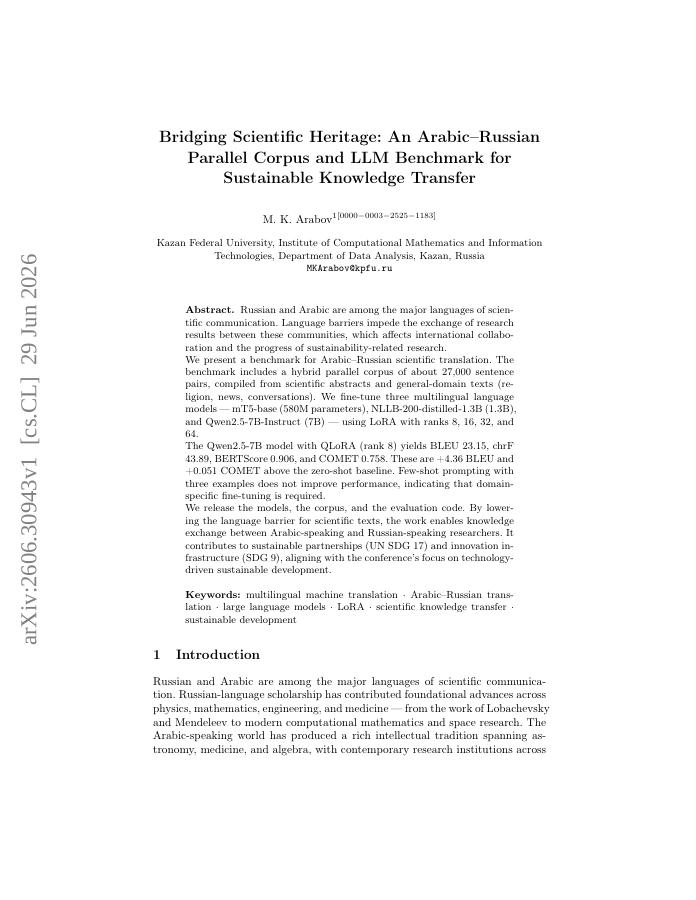
Russian and Arabic are among the major languages of scientific communication. Language barriers impede the exchange of research results between these communities, which affects international collaboration and the progress of sustainability-related research. We present a benchmark for Arabic--Russian scientific translation. The benchmark includes a hybrid parallel corpus of about 27,000 sentence pairs, compiled from scientific abstracts and general-domain texts (religion, news, conversations). We fine-tune three multilingual language models -- mT5-base (580M parameters), NLLB-200-distilled-1.3B (1.3B), and Qwen2.5-7B-Instruct (7B) -- using LoRA with ranks 8, 16, 32, and 64. The Qwen2.5-7B model with QLoRA (rank 8) yields BLEU 23.15, chrF 43.89, BERTScore 0.906, and COMET 0.758. These are +4.36 BLEU and +0.051 COMET above the zero-shot baseline. Few-shot prompting with three examples does not improve performance, indicating that domain-specific fine-tuning is required. We release the models, the corpus, and the evaluation code. By lowering the language barrier for scientific texts, the work enables knowledge exchange between Arabic-speaking and Russian-speaking researchers. It contributes to sustainable partnerships (UN SDG 17) and innovation infrastructure (SDG 9), aligning with the conference's focus on technology-driven sustainable development.
Bridging Scientific Heritage: An Arabic--Russian Parallel Corpus and LLM Benchmark for Sustainable Knowledge Transfer
Russian and Arabic are among the major languages of scientific communication. Language barriers impede the exchange of research results between these communities, which affects international collaboration and the progress of sustainability-related research.
- Preview
- Year
- 2026
- Hosting
- Abstract onlyARXIV-DEFAULT
Cite
Notes
Only stored in your browser.
Attribution
- Abstract & full text
- arxiv.org/abs/2606.30943ARXIV-DEFAULT
- TL;DR
- Semantic Scholar