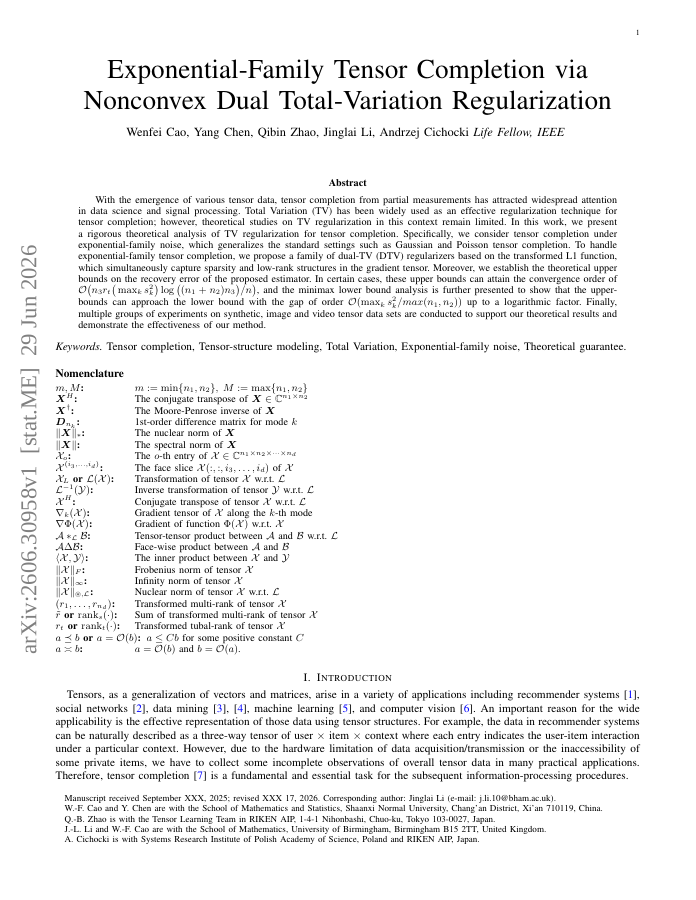
With the emergence of various tensor data, tensor completion from partial measurements has attracted widespread attention in data science and signal processing. Total Variation (TV) has been widely used as an effective regularization technique for tensor completion; however, theoretical studies on TV regularization in this context remain limited. In this work, we present a rigorous theoretical analysis of TV regularization for tensor completion. Specifically, we consider tensor completion under exponential-family noise, which generalizes the standard settings such as Gaussian and Poisson tensor completion. To handle exponential-family tensor completion, we propose a family of dual-TV (DTV) regularizers based on the transformed L1 function, which simultaneously capture sparsity and low-rank structures in the gradient tensor. Moreover, we establish the theoretical upper bounds on the recovery error of the proposed estimator. In certain cases, these upper bounds can attain the convergence order of O\big( n_3 r_t\big(\max_{k} s_k^2\big) \log\big((n_1+n_2)n_3\big) /n \big), and the minimax lower bound analysis is further presented to show that the upper-bounds can approach the lower bound with the gap of order O(\max_k s_k^2/max(n_1, n_2)) up to a logarithmic factor. Finally, multiple groups of experiments on synthetic, image and video tensor data sets are conducted to support our theoretical results and demonstrate the effectiveness of our method.
Exponential-Family Tensor Completion via Nonconvex Dual Total-Variation Regularization
With the emergence of various tensor data, tensor completion from partial measurements has attracted widespread attention in data science and signal processing. Total Variation (TV) has been widely used as an effective regularization technique for tensor completion; however,…
- Preview
- Year
- 2026
- Hosting
- Abstract onlyARXIV-DEFAULT
Cite
Notes
Only stored in your browser.
Attribution
- Abstract & full text
- arxiv.org/abs/2606.30958ARXIV-DEFAULT
- TL;DR
- Semantic Scholar