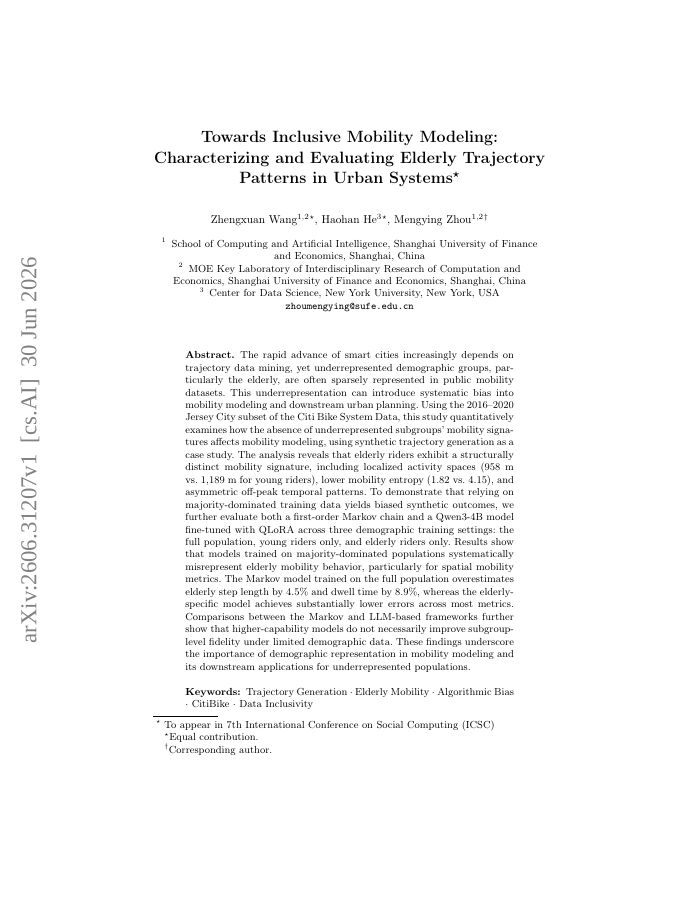
The rapid advance of smart cities increasingly depends on trajectory data mining, yet underrepresented demographic groups, particularly the elderly, are often sparsely represented in public mobility datasets. This underrepresentation can introduce systematic bias into mobility modeling and downstream urban planning. Using the 2016-2020 Jersey City subset of the Citi Bike System Data, this study quantitatively examines how the absence of underrepresented subgroups' mobility signatures affects mobility modeling, using synthetic trajectory generation as a case study. The analysis reveals that elderly riders exhibit a structurally distinct mobility signature, including localized activity spaces (958 m vs. 1,189 m for young riders), lower mobility entropy (1.82 vs. 4.15), and asymmetric off-peak temporal patterns. To demonstrate that relying on majority-dominated training data yields biased synthetic outcomes, we further evaluate both a first-order Markov chain and a Qwen3-4B model fine-tuned with QLoRA across three demographic training settings: the full population, young riders only, and elderly riders only. Results show that models trained on majority-dominated populations systematically misrepresent elderly mobility behavior, particularly for spatial mobility metrics. The Markov model trained on the full population overestimates elderly step length by 4.5% and dwell time by 8.9%, whereas the elderly-specific model achieves substantially lower errors across most metrics. Comparisons between the Markov and LLM-based frameworks further show that higher-capability models do not necessarily improve subgroup-level fidelity under limited demographic data. These findings underscore the importance of demographic representation in mobility modeling and its downstream applications for underrepresented populations.
Towards Inclusive Mobility Modeling: Characterizing and Evaluating Elderly Trajectory Patterns in Urban Systems
The rapid advance of smart cities increasingly depends on trajectory data mining, yet underrepresented demographic groups, particularly the elderly, are often sparsely represented in public mobility datasets.
- Preview
- Year
- 2026
- Hosting
- Full text hostedCC-BY-SA-4.0
Cite
Notes
Only stored in your browser.
Attribution
- Abstract & full text
- arxiv.org/abs/2606.31207CC-BY-SA-4.0
- TL;DR
- Semantic Scholar