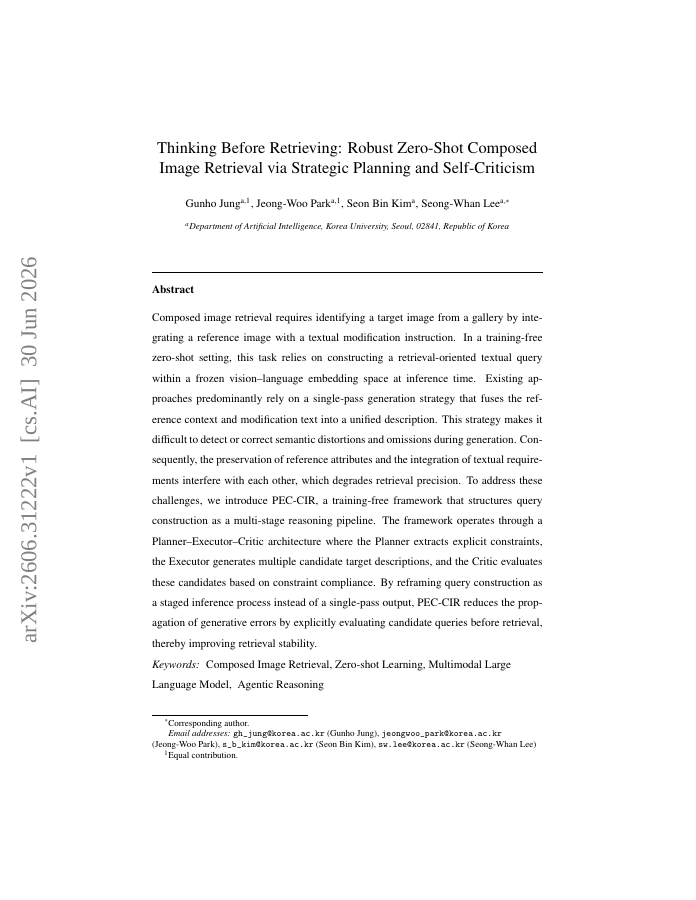
Composed image retrieval requires identifying a target image from a gallery by integrating a reference image with a textual modification instruction. In a training-free zero-shot setting, this task relies on constructing a retrieval-oriented textual query within a frozen vision--language embedding space at inference time. Existing approaches predominantly rely on a single-pass generation strategy that fuses the reference context and modification text into a unified description. This strategy makes it difficult to detect or correct semantic distortions and omissions during generation. Consequently, the preservation of reference attributes and the integration of textual requirements interfere with each other, which degrades retrieval precision. To address these challenges, we introduce PEC-CIR, a training-free framework that structures query construction as a multi-stage reasoning pipeline. The framework operates through a Planner--Executor--Critic architecture where the Planner extracts explicit constraints, the Executor generates multiple candidate target descriptions, and the Critic evaluates these candidates based on constraint compliance. By reframing query construction as a staged inference process instead of a single-pass output, PEC-CIR reduces the propagation of generative errors by explicitly evaluating candidate queries before retrieval, thereby improving retrieval stability.
Thinking Before Retrieving: Robust Zero-Shot Composed Image Retrieval via Strategic Planning and Self-Criticism
Composed image retrieval requires identifying a target image from a gallery by integrating a reference image with a textual modification instruction. In a training-free zero-shot setting, this task relies on constructing a retrieval-oriented textual query within a frozen…
- Preview
- Year
- 2026
- Hosting
- Full text hostedCC-BY-SA-4.0
Cite
Notes
Only stored in your browser.
Attribution
- Abstract & full text
- arxiv.org/abs/2606.31222CC-BY-SA-4.0
- TL;DR
- Semantic Scholar