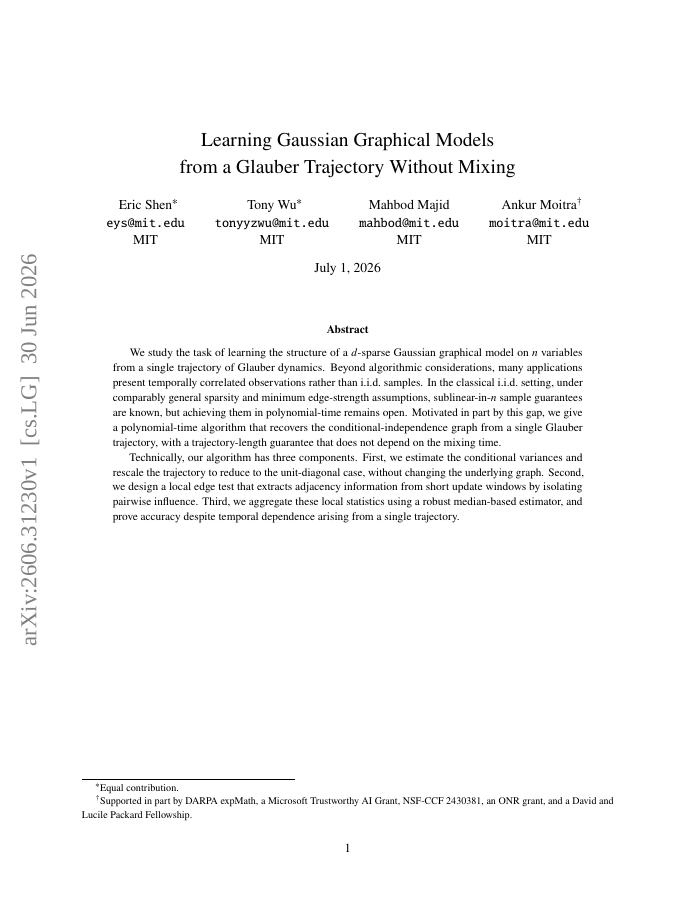
We study the task of learning the structure of a d-sparse Gaussian graphical model on n variables from a single trajectory of Glauber dynamics. Beyond algorithmic considerations, many applications present temporally correlated observations rather than i.i.d.\ samples. In the classical i.i.d.\ setting, under comparably general sparsity and minimum edge-strength assumptions, sublinear-in-n sample guarantees are known, but achieving them in polynomial-time remains open. Motivated in part by this gap, we give a polynomial-time algorithm that recovers the conditional-independence graph from a single Glauber trajectory, with a trajectory-length guarantee that does not depend on the mixing time. Technically, our algorithm has three components. First, we estimate the conditional variances and rescale the trajectory to reduce to the unit-diagonal case, without changing the underlying graph. Second, we design a local edge test that extracts adjacency information from short update windows by isolating pairwise influence. Third, we aggregate these local statistics using a robust median-based estimator, and prove accuracy despite temporal dependence arising from a single trajectory.
Learning Gaussian Graphical Models from a Glauber Trajectory Without Mixing
We study the task of learning the structure of a $d$-sparse Gaussian graphical model on $n$ variables from a single trajectory of Glauber dynamics. Beyond algorithmic considerations, many applications present temporally correlated observations rather than i.i.d.\ samples.
- Preview
- Year
- 2026
- Hosting
- Abstract onlyARXIV-DEFAULT
Cite
Notes
Only stored in your browser.
Attribution
- Abstract & full text
- arxiv.org/abs/2606.31230ARXIV-DEFAULT
- TL;DR
- Semantic Scholar