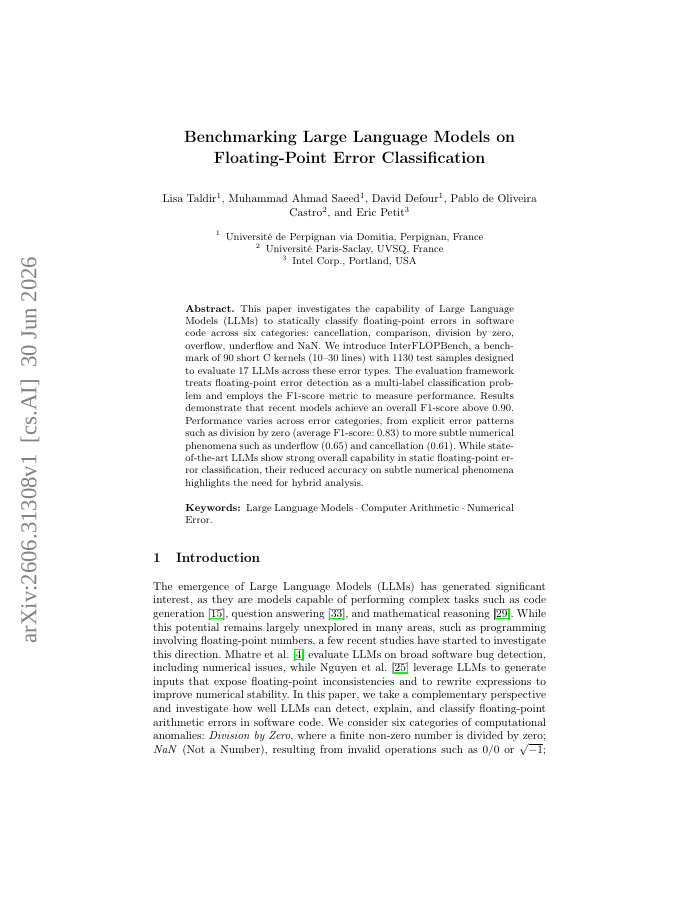
This paper investigates the capability of Large Language Models (LLMs) to detect and classify floating-point errors statically in software code. We introduce InterFLOPBench, a benchmark of 90 C kernels with 1 130 test samples designed to evaluate LLMs across six categories of floating-point error: cancellation, comparison, division by zero, overflow, underflow and NaN, compared across 14 LLMs. The evaluation framework treats floating-point error detection as a multi-label classification problem and employs the F1-score metric to measure performance. Results demonstrate that latest models (Qwen 3 32b, Gemini 2.5 Flash, Phi 4 Reasoning, DeepSeek R1T2, and gpt-oss 20b and 120b) achieve a performance greater than 0.88 overall F1-score. Performance varies between error categories, between explicit operations such as division by zero (Average F1-score: 0.8479) and more subtle numerical phenomena such as underflow (Average F1-score: 0.6059) and cancellation (Average F1-score: 0.6164).
Benchmarking Large Language Models on Floating-Point Error Classification
This paper investigates the capability of Large Language Models (LLMs) to detect and classify floating-point errors statically in software code. We introduce InterFLOPBench, a benchmark of 90 C kernels with 1 130 test samples designed to evaluate LLMs across six categories of…
- Preview
- Year
- 2026
- Hosting
- Abstract onlyARXIV-DEFAULT
Cite
Notes
Only stored in your browser.
Attribution
- Abstract & full text
- arxiv.org/abs/2606.31308ARXIV-DEFAULT
- TL;DR
- Semantic Scholar