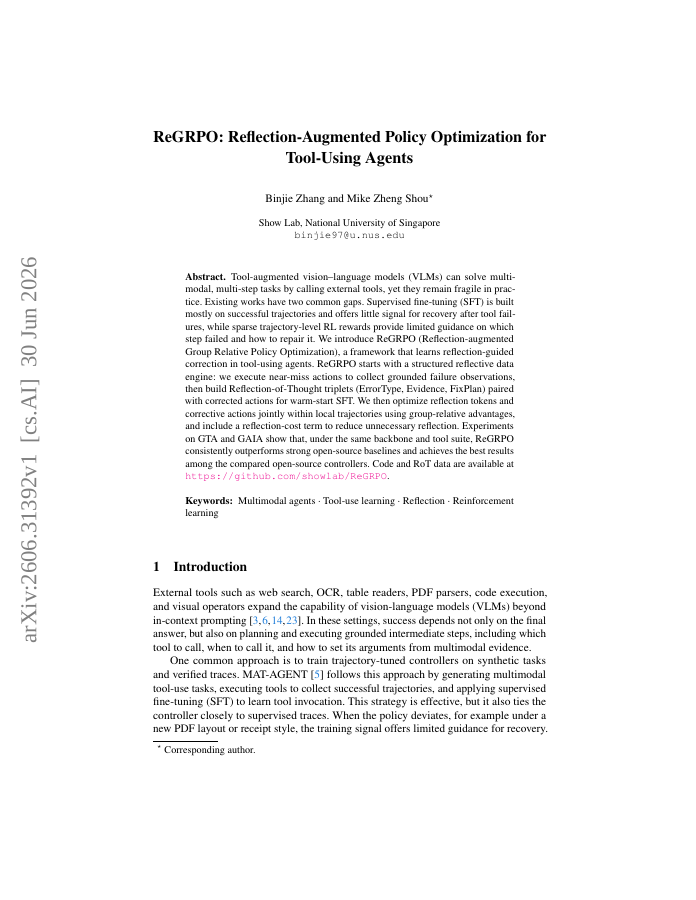
Tool-augmented vision-language models (VLMs) can solve multimodal, multi-step tasks by calling external tools, yet they remain fragile in practice. Existing works have two common gaps. Supervised fine-tuning (SFT) is built mostly on successful trajectories and offers little signal for recovery after tool failures, while sparse trajectory-level RL rewards provide limited guidance on which step failed and how to repair it. We introduce ReGRPO (Reflection-augmented Group Relative Policy Optimization), a framework that learns reflection-guided correction in tool-using agents. ReGRPO starts with a structured reflective data engine: we execute near-miss actions to collect grounded failure observations, then build Reflection-of-Thought triplets (ErrorType, Evidence, FixPlan) paired with corrected actions for warm-start SFT. We then optimize reflection tokens and corrective actions jointly within local trajectories using group-relative advantages, and include a reflection-cost term to reduce unnecessary reflection. Experiments on GTA and GAIA show that, under the same backbone and tool suite, ReGRPO consistently outperforms strong open-source baselines and achieves the best results among the compared open-source controllers. Code and RoT data are available at https://github.com/showlab/ReGRPO.
ReGRPO: Reflection-Augmented Policy Optimization for Tool-Using Agents
Tool-augmented vision-language models (VLMs) can solve multimodal, multi-step tasks by calling external tools, yet they remain fragile in practice. Existing works have two common gaps.
- Preview
- Year
- 2026
- Hosting
- Full text hostedCC-BY-4.0
Cite
Notes
Only stored in your browser.
Attribution
- Abstract & full text
- arxiv.org/abs/2606.31392CC-BY-4.0
- TL;DR
- Semantic Scholar