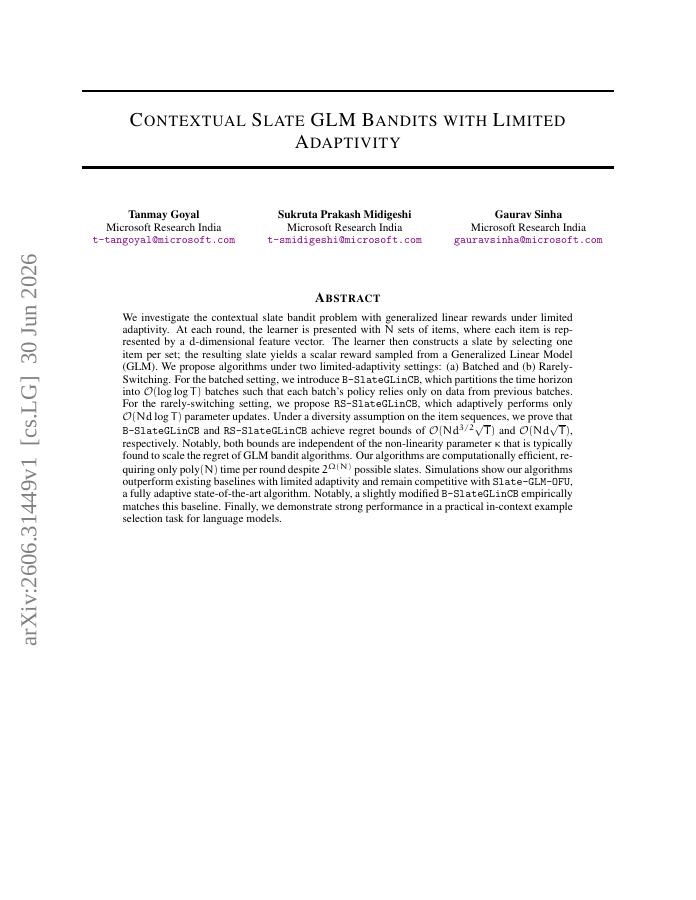
We investigate the contextual slate bandit problem with generalized linear rewards under limited adaptivity. At each round, the learner is presented with N sets of items, where each item is represented by a d-dimensional feature vector. The learner then constructs a slate by selecting one item per set; the resulting slate yields a scalar reward sampled from a Generalized Linear Model (GLM). We propose algorithms under two limited-adaptivity settings: (a) Batched and (b) Rarely-Switching. For the batched setting, we introduce B-SlateGLinCB, which partitions the time horizon into O(\log\log T) batches such that each batch's policy relies only on data from previous batches. For the rarely-switching setting, we propose RS-SlateGLinCB, which adaptively performs only O(Nd\log T) parameter updates. Under a diversity assumption on the item sequences, we prove that B-SlateGLinCB and RS-SlateGLinCB achieve regret bounds of O(Nd^{3/2}\sqrt{T}) and O(Nd\sqrt{T}), respectively. Notably, both bounds are independent of the non-linearity parameter κ that is typically found to scale the regret of GLM bandit algorithms. Our algorithms are computationally efficient, requiring only poly(N) time per round despite 2^{Ω(N)} possible slates. Simulations show our algorithms outperform existing baselines with limited adaptivity and remain competitive with Slate-GLM-OFU, a fully adaptive state-of-the-art algorithm. Notably, a slightly modified B-SlateGLinCB empirically matches this baseline. Finally, we demonstrate strong performance in a practical in-context example selection task for language models.
Contextual Slate GLM Bandits with Limited Adaptivity
We investigate the contextual slate bandit problem with generalized linear rewards under limited adaptivity. At each round, the learner is presented with $N$ sets of items, where each item is represented by a $d$-dimensional feature vector.
- Preview
- Year
- 2026
- Hosting
- Excerpt onlyCC-BY-NC-SA-4.0
Cite
Notes
Only stored in your browser.
Attribution
- Abstract & full text
- arxiv.org/abs/2606.31449CC-BY-NC-SA-4.0
- TL;DR
- Semantic Scholar