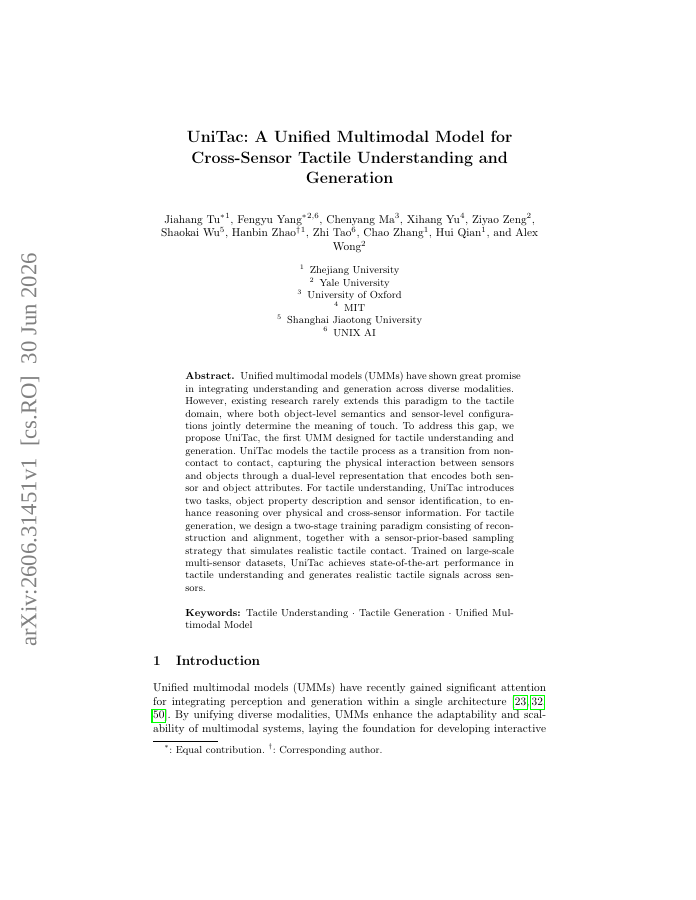
Unified multimodal models (UMMs) have shown great promise in integrating understanding and generation across diverse modalities. However, existing research rarely extends this paradigm to the tactile domain, where both object-level semantics and sensor-level configurations jointly determine the meaning of touch. To address this gap, we propose UniTac, the first UMM designed for tactile understanding and generation. UniTac models the tactile process as a transition from non-contact to contact, capturing the physical interaction between sensors and objects through a dual-level representation that encodes both sensor and object attributes. For tactile understanding, UniTac introduces two tasks, object property description and sensor identification, to enhance reasoning over physical and cross-sensor information. For tactile generation, we design a two-stage training paradigm consisting of reconstruction and alignment, together with a sensor-prior-based sampling strategy that simulates realistic tactile contact. Trained on large-scale multi-sensor datasets, UniTac achieves state-of-the-art performance in tactile understanding and generates realistic tactile signals across sensors.
UniTac: A Unified Multimodal Model for Cross-Sensor Tactile Understanding and Generation
Unified multimodal models (UMMs) have shown great promise in integrating understanding and generation across diverse modalities. However, existing research rarely extends this paradigm to the tactile domain, where both object-level semantics and sensor-level configurations…
- Preview
- Year
- 2026
- Hosting
- Abstract onlyARXIV-DEFAULT
Cite
Notes
Only stored in your browser.
Attribution
- Abstract & full text
- arxiv.org/abs/2606.31451ARXIV-DEFAULT
- TL;DR
- Semantic Scholar