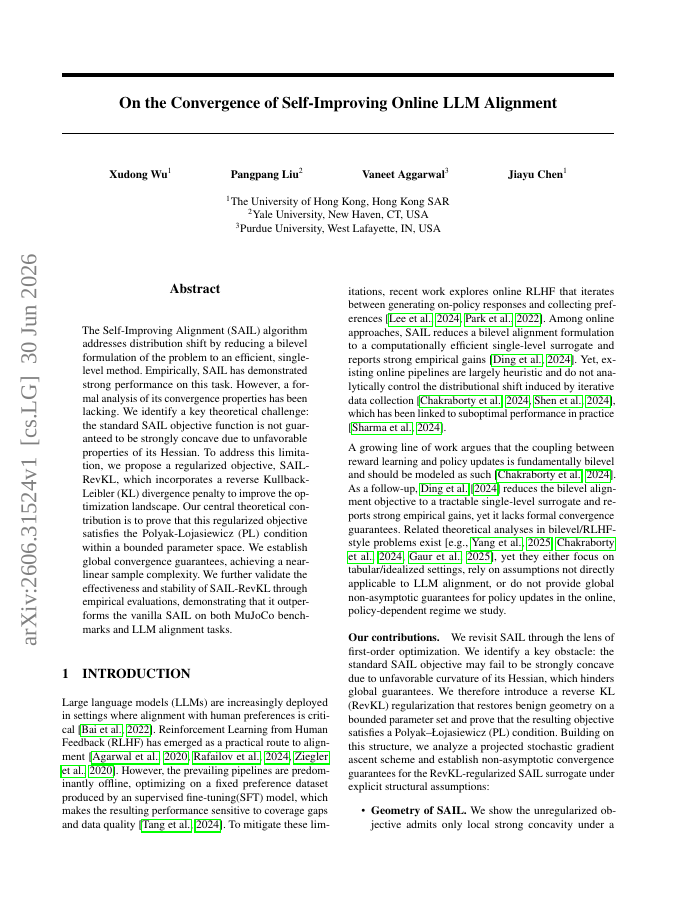
The Self-Improving Alignment (SAIL) algorithm addresses distribution shift by reducing a bilevel formulation of the problem to an efficient, single-level method. Empirically, SAIL has demonstrated strong performance on this task. However, a formal analysis of its convergence properties has been lacking. We identify a key theoretical challenge: the standard SAIL objective function is not guaranteed to be strongly concave due to unfavorable properties of its Hessian. To address this limitation, we propose a regularized objective, SAIL-RevKL, which incorporates a reverse Kullback-Leibler (KL) divergence penalty to improve the optimization landscape. Our central theoretical contribution is to prove that this regularized objective satisfies the Polyak-Lojasiewicz (PL) condition within a bounded parameter space. We establish global convergence guarantees, achieving a near-linear sample complexity. We further validate the effectiveness and stability of SAIL-RevKL through empirical evaluations, demonstrating that it outperforms the vanilla SAIL on both MuJoCo benchmarks and LLM alignment tasks.
On the Convergence of Self-Improving Online LLM Alignment
The Self-Improving Alignment (SAIL) algorithm addresses distribution shift by reducing a bilevel formulation of the problem to an efficient, single-level method. Empirically, SAIL has demonstrated strong performance on this task.
- Preview
- Year
- 2026
- Hosting
- Full text hostedCC-BY-4.0
Cite
Notes
Only stored in your browser.
Attribution
- Abstract & full text
- arxiv.org/abs/2606.31524CC-BY-4.0
- TL;DR
- Semantic Scholar