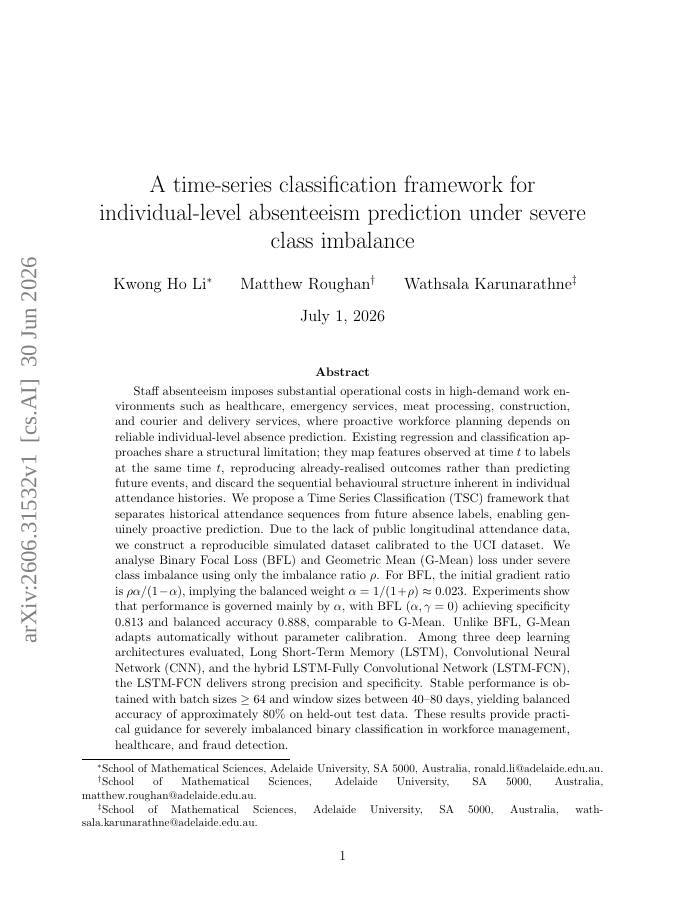
Staff absenteeism imposes substantial operational costs in high-demand work environments such as healthcare, emergency services, meat processing, construction, and courier and delivery services, where proactive workforce planning depends on reliable individual-level absence prediction. Existing regression and classification approaches share a structural limitation; they map features observed at time t to labels at the same time t, reproducing already-realised outcomes rather than predicting future events, and discard the sequential behavioural structure inherent in individual attendance histories. We propose a Time Series Classification (TSC) framework that separates historical attendance sequences from future absence labels, enabling genuinely proactive prediction. Due to the lack of public longitudinal attendance data, we construct a reproducible simulated dataset calibrated to the UCI dataset. We analyse Binary Focal Loss (BFL) and Geometric Mean (G-Mean) loss under severe class imbalance using only the imbalance ratio ρ. For BFL, the initial gradient ratio is ρα/(1-α), implying the balanced weight α= 1/(1+ρ) \approx 0.023. Experiments show that performance is governed mainly by α, with BFL achieving specificity 0.813 and balanced accuracy 0.888, comparable to G-Mean. Unlike BFL, G-Mean adapts automatically without parameter calibration. Among three deep learning architectures evaluated, Long Short-Term Memory (LSTM), Convolutional Neural Network (CNN), and the hybrid LSTM-Fully Convolutional Network (LSTM-FCN), the LSTM-FCN delivers strong precision and specificity. Stable performance is obtained with batch sizes >= 64 and window sizes between 40-80 days, yielding balanced accuracy of approximately 80% on held-out test data.
A time-series classification framework for individual-level absenteeism prediction under severe class imbalance
Staff absenteeism imposes substantial operational costs in high-demand work environments such as healthcare, emergency services, meat processing, construction, and courier and delivery services, where proactive workforce planning depends on reliable individual-level absence…
- Preview
- Year
- 2026
- Hosting
- Full text hostedCC-BY-4.0
Cite
Notes
Only stored in your browser.
Attribution
- Abstract & full text
- arxiv.org/abs/2606.31532CC-BY-4.0
- TL;DR
- Semantic Scholar