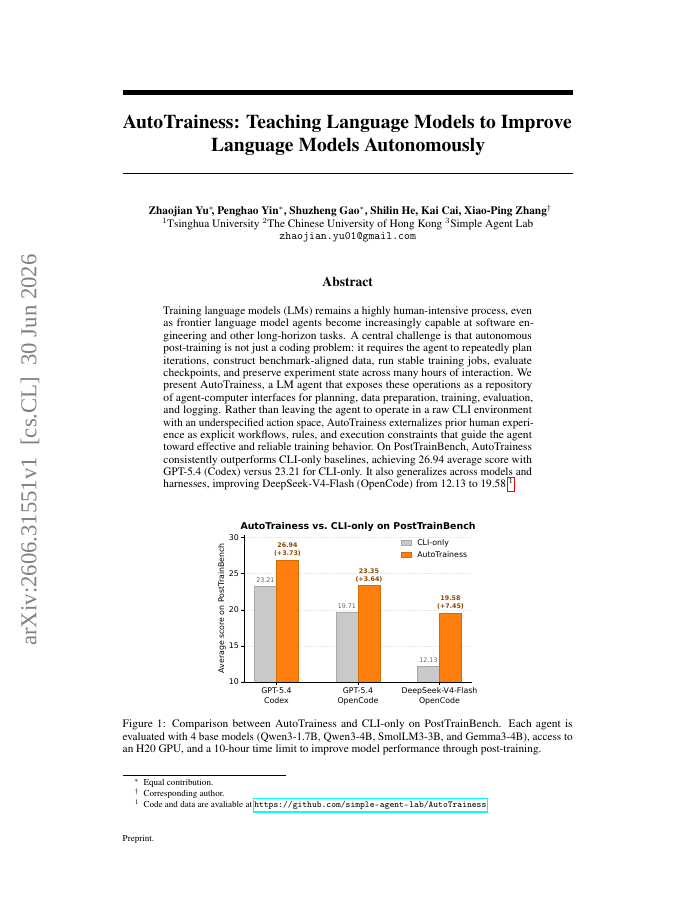
Training language models (LMs) remains a highly human-intensive process, even as frontier language model agents become increasingly capable at software engineering and other long-horizon tasks. A central challenge is that autonomous post-training is not just a coding problem: it requires the agent to repeatedly plan iterations, construct benchmark-aligned data, run stable training jobs, evaluate checkpoints, and preserve experiment state across many hours of interaction. We present AutoTrainess, a LM agent that exposes these operations as a repository of agent-computer interfaces for planning, data preparation, training, evaluation, and logging. Rather than leaving the agent to operate in a raw CLI environment with an underspecified action space, AutoTrainess externalizes prior human experience as explicit workflows, rules, and execution constraints that guide the agent toward effective and reliable training behavior. On PostTrainBench, AutoTrainess consistently outperforms CLI-only baselines, achieving 26.94 average score with GPT-5.4 (Codex) versus 23.21 for CLI-only. It also generalizes across models and harnesses, improving DeepSeek-V4-Flash (OpenCode) from 12.13 to 19.58.
AutoTrainess: Teaching Language Models to Improve Language Models Autonomously
Training language models (LMs) remains a highly human-intensive process, even as frontier language model agents become increasingly capable at software engineering and other long-horizon tasks.
- Preview
- Year
- 2026
- Hosting
- Abstract onlyARXIV-DEFAULT
Cite
Notes
Only stored in your browser.
Attribution
- Abstract & full text
- arxiv.org/abs/2606.31551ARXIV-DEFAULT
- TL;DR
- Semantic Scholar