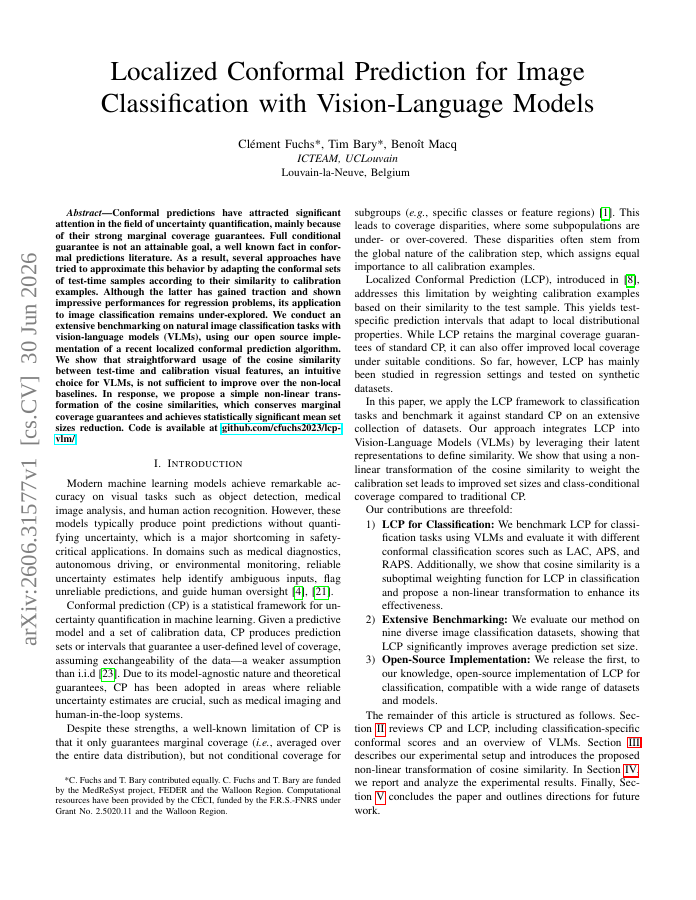
Conformal predictions have attracted significant attention in the field of uncertainty quantification, mainly because of their strong marginal coverage guarantees. Full conditional guarantee is not an attainable goal, a well known fact in conformal predictions literature. As a result, several approaches have tried to approximate this behavior by adapting the conformal sets of test-time samples according to their similarity to calibration examples. Although the latter has gained traction and shown impressive performances for regression problems, its application to image classification remains under-explored. We conduct an extensive benchmarking on natural image classification tasks with vision-language models (VLMs), using our open source implementation of a recent localized conformal prediction algorithm. We show that straightforward usage of the cosine similarity between test-time and calibration visual features, an intuitive choice for VLMs, is not sufficient to improve over the non-local baselines. In response, we propose a simple non-linear transformation of the cosine similarities, which conserves marginal coverage guarantees and achieves statistically significant mean set sizes reduction. Code is available at https://github.com/cfuchs2023/lcp-vlm/.
Localized Conformal Prediction for Image Classification with Vision-Language Models
Conformal predictions have attracted significant attention in the field of uncertainty quantification, mainly because of their strong marginal coverage guarantees. Full conditional guarantee is not an attainable goal, a well known fact in conformal predictions literature.
- Preview
- Year
- 2026
- Hosting
- Full text hostedCC-BY-4.0
Cite
Notes
Only stored in your browser.
Attribution
- Abstract & full text
- arxiv.org/abs/2606.31577CC-BY-4.0
- TL;DR
- Semantic Scholar