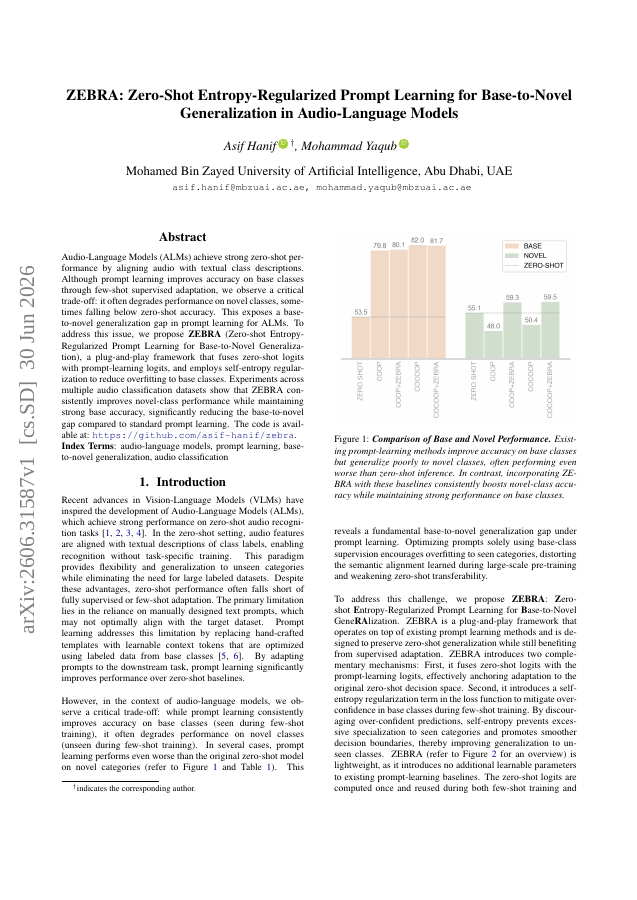
Audio-Language Models (ALMs) achieve strong zero-shot performance by aligning audio with textual class descriptions. Although prompt learning improves accuracy on base classes through few-shot supervised adaptation, we observe a critical trade-off: it often degrades performance on novel classes, sometimes falling below zero-shot accuracy. This exposes a base-to-novel generalization gap in prompt learning for ALMs. To address this issue, we propose ZEBRA (Zero-shot Entropy-Regularized Prompt Learning for Base-to-Novel Generalization), a plug-and-play framework that fuses zero-shot logits with prompt-learning logits, and employs self-entropy regularization to reduce overfitting to base classes. Experiments across multiple audio classification datasets show that ZEBRA consistently improves novel-class performance while maintaining strong base accuracy, significantly reducing the base-to-novel gap compared to standard prompt learning. The code is available at: https://github.com/asif-hanif/zebra.
ZEBRA: Zero-Shot Entropy-Regularized Prompt Learning for Base-to-Novel Generalization in Audio-Language Models
Audio-Language Models (ALMs) achieve strong zero-shot performance by aligning audio with textual class descriptions. Although prompt learning improves accuracy on base classes through few-shot supervised adaptation, we observe a critical trade-off: it often degrades performance…
- Preview
- Year
- 2026
- Hosting
- Full text hostedCC-BY-4.0
Cite
Notes
Only stored in your browser.
Attribution
- Abstract & full text
- arxiv.org/abs/2606.31587CC-BY-4.0
- TL;DR
- Semantic Scholar