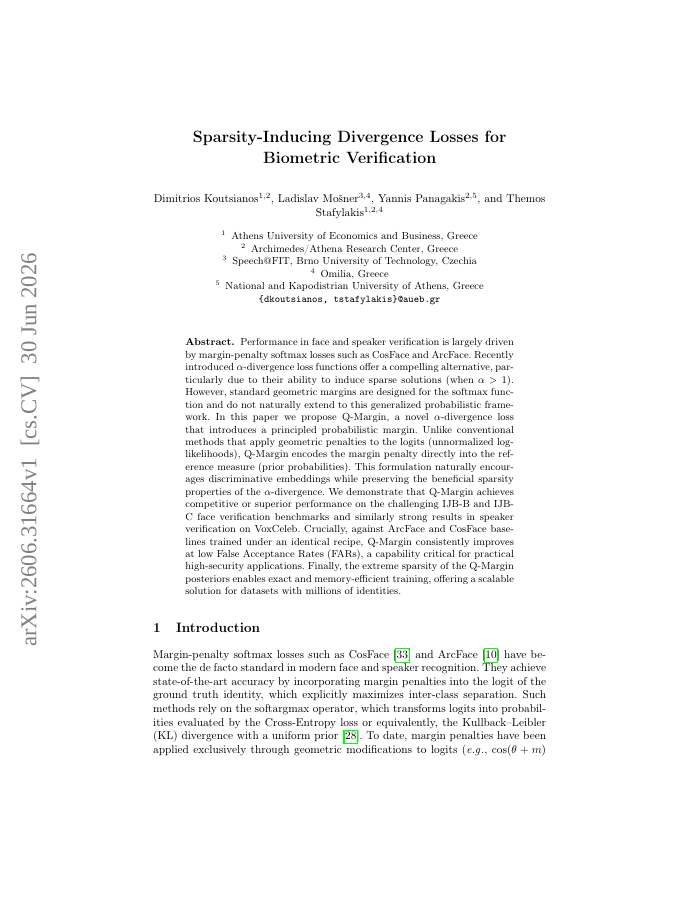
Performance in face and speaker verification is largely driven by margin-penalty softmax losses such as CosFace and ArcFace. Recently introduced α-divergence loss functions offer a compelling alternative, particularly due to their ability to induce sparse solutions (when α>1). However, standard geometric margins are designed for the softmax function and do not naturally extend to this generalized probabilistic framework. In this paper we propose Q-Margin, a novel α-divergence loss that introduces a principled probabilistic margin. Unlike conventional methods that apply geometric penalties to the logits (unnormalized log-likelihoods), Q-Margin encodes the margin penalty directly into the reference measure (prior probabilities). This formulation naturally encourages discriminative embeddings while preserving the beneficial sparsity properties of the α-divergence. We demonstrate that Q-Margin achieves competitive or superior performance on the challenging IJB-B and IJB-C face verification benchmarks and similarly strong results in speaker verification on VoxCeleb. Crucially, against ArcFace and CosFace baselines trained under an identical recipe, Q-Margin consistently improves at low False Acceptance Rates (FARs), a capability critical for practical high-security applications. Finally, the extreme sparsity of the Q-Margin posteriors enables exact and memory-efficient training, offering a scalable solution for datasets with millions of identities.
Sparsity-Inducing Divergence Losses for Biometric Verification
Performance in face and speaker verification is largely driven by margin-penalty softmax losses such as CosFace and ArcFace. Recently introduced $α$-divergence loss functions offer a compelling alternative, particularly due to their ability to induce sparse solutions (when…
- Preview
- Year
- 2026
- Hosting
- Full text hostedCC-BY-4.0
Cite
Notes
Only stored in your browser.
Attribution
- Abstract & full text
- arxiv.org/abs/2606.31664CC-BY-4.0
- TL;DR
- Semantic Scholar