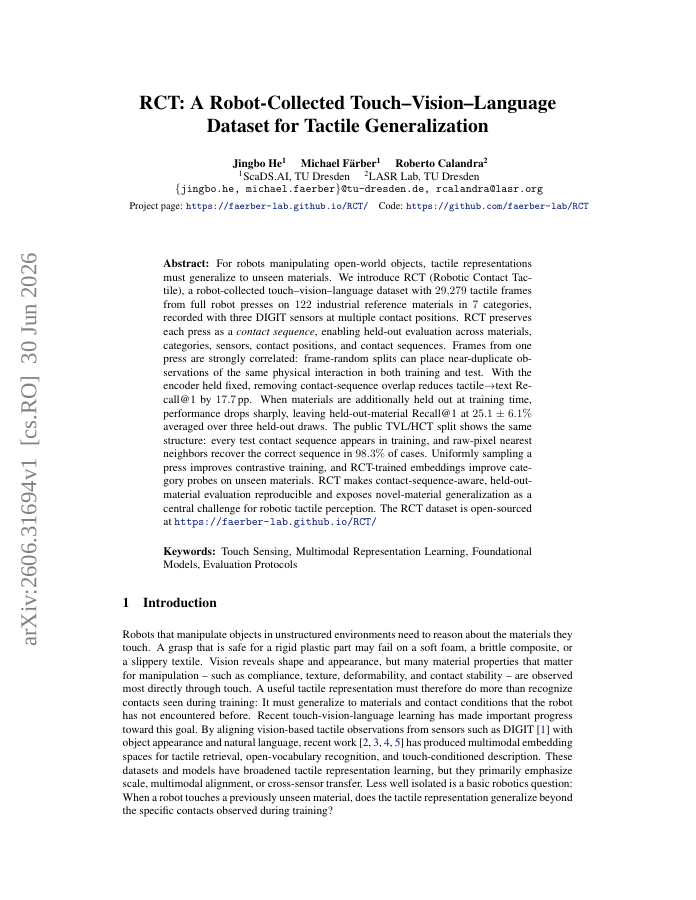
For robots manipulating open-world objects, tactile representations must generalize to unseen materials. We introduce RCT (Robotic Contact Tactile), a robot-collected touch-vision-language dataset with 29,279 tactile frames from full robot presses on 122 industrial reference materials in 7 categories, recorded with three DIGIT sensors at multiple contact positions. RCT preserves each press as a contact sequence, enabling held-out evaluation across materials, categories, sensors, contact positions, and contact sequences. Frames from one press are strongly correlated: frame-random splits can place near-duplicate observations of the same physical interaction in both training and test. With the encoder held fixed, removing contact-sequence overlap reduces tactile-to-text Recall@1 by 17.7 percentage points. When materials are additionally held out at training time, performance drops sharply, leaving held-out-material Recall@1 at 25.1 +/- 6.1% averaged over three held-out draws. The public TVL/HCT split shows the same structure: every test contact sequence appears in training, and raw-pixel nearest neighbors recover the correct sequence in 98.3% of cases. Uniformly sampling a press improves contrastive training, and RCT-trained embeddings improve category probes on unseen materials. RCT makes contact-sequence-aware, held-out-material evaluation reproducible and exposes novel-material generalization as a central challenge for robotic tactile perception. The RCT dataset is open-sourced at https://faerber-lab.github.io/RCT/
RCT: A Robot-Collected Touch-Vision-Language Dataset for Tactile Generalization
For robots manipulating open-world objects, tactile representations must generalize to unseen materials. We introduce RCT (Robotic Contact Tactile), a robot-collected touch-vision-language dataset with 29,279 tactile frames from full robot presses on 122 industrial reference…
- Preview
- Year
- 2026
- Hosting
- Abstract onlyARXIV-DEFAULT
Cite
Notes
Only stored in your browser.
Attribution
- Abstract & full text
- arxiv.org/abs/2606.31694ARXIV-DEFAULT
- TL;DR
- Semantic Scholar