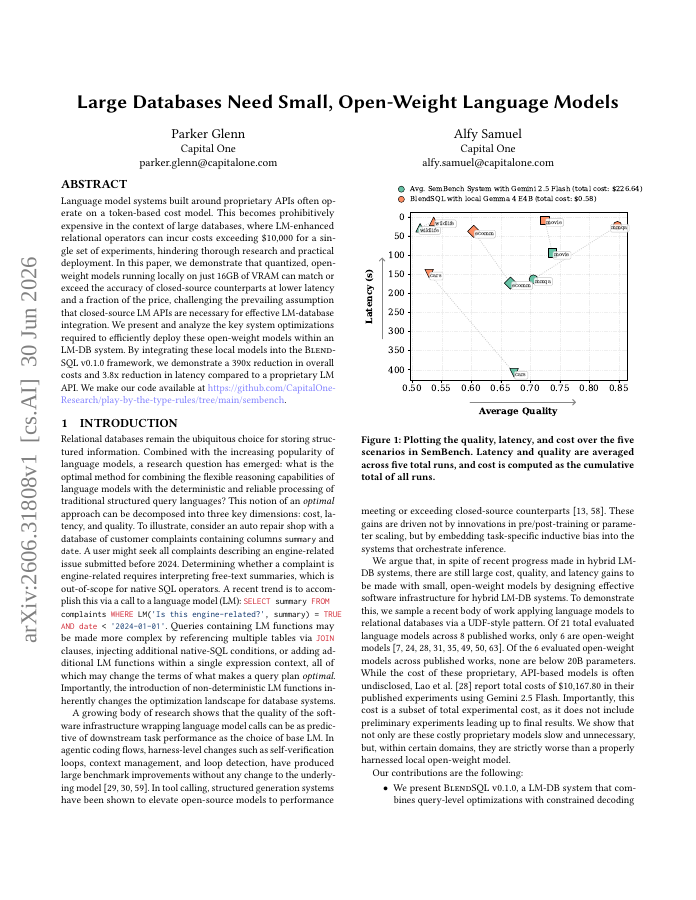
Language model systems built around proprietary APIs often operate on a token-based cost model. This becomes prohibitively expensive in the context of large databases, where LM-enhanced relational operators can incur costs exceeding $10,000 for a single set of experiments, hindering thorough research and practical deployment. In this paper, we demonstrate that quantized, open-weight models running locally on just 16GB of VRAM can match or exceed the accuracy of closed-source counterparts at lower latency and a fraction of the price, challenging the prevailing assumption that closed-source LM APIs are necessary for effective LM-database integration. We present and analyze the key system optimizations required to efficiently deploy these open-weight models within an LM-DB system. By integrating these local models into the BlendSQL v0.1.0 framework, we demonstrate a 390x reduction in overall costs and 3.8x reduction in latency compared to a proprietary LM API. We make our code available at https://github.com/CapitalOne-Research/play-by-the-type-rules/tree/main/sembench.
Large Databases Need Small, Open-Weight Language Models
Language model systems built around proprietary APIs often operate on a token-based cost model. This becomes prohibitively expensive in the context of large databases, where LM-enhanced relational operators can incur costs exceeding $10,000 for a single set of experiments,…
- Preview
- Year
- 2026
- Hosting
- Full text hostedCC-BY-4.0
Cite
Notes
Only stored in your browser.
Attribution
- Abstract & full text
- arxiv.org/abs/2606.31808CC-BY-4.0
- TL;DR
- Semantic Scholar