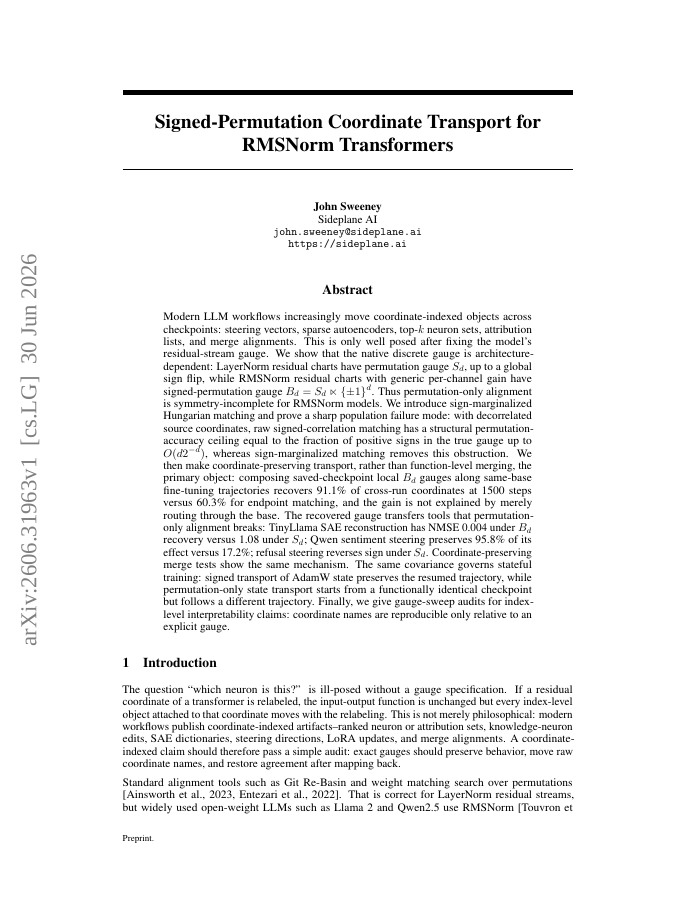
Modern LLM workflows move coordinate-indexed objects across checkpoints: steering vectors, sparse autoencoders, top-k neuron sets, attribution lists, and merge alignments. This is only well posed after fixing the model's residual-stream gauge, which we show is architecture-dependent: LayerNorm residual charts have permutation gauge S_d (up to a global sign flip), while RMSNorm charts with generic per-channel gain have signed-permutation gauge B_d = S_d \ltimes {\pm 1}^d. Permutation-only alignment is therefore symmetry-incomplete for RMSNorm models. We introduce sign-marginalized Hungarian matching and prove a sharp failure mode: with decorrelated coordinates, raw signed-correlation matching has a structural permutation-accuracy ceiling at the positive-sign fraction of the true gauge, which sign-marginalization removes. We then make coordinate-preserving transport, not function-level merging, the primary object: composing saved-checkpoint local B_d gauges along same-base fine-tuning trajectories recovers 91.1% of cross-run coordinates at 1500 steps versus 60.3% for endpoint matching, and the gain is not explained by merely routing through the base. The recovered gauge transfers tools that permutation-only alignment breaks: TinyLlama SAE reconstruction has NMSE 0.004 under B_d versus 1.08 under S_d; Qwen sentiment steering preserves 95.8% of its effect versus 17.2%; refusal steering reverses sign under S_d; coordinate-preserving merges behave the same way. The same covariance governs stateful training: signed transport of AdamW state preserves the resumed trajectory, while permutation-only state follows a different one from a functionally identical checkpoint. Finally, gauge-sweep audits show index-level interpretability claims are reproducible only relative to an explicit gauge.
Signed-Permutation Coordinate Transport for RMSNorm Transformers
Modern LLM workflows move coordinate-indexed objects across checkpoints: steering vectors, sparse autoencoders, top-$k$ neuron sets, attribution lists, and merge alignments.
- Preview
- Year
- 2026
- Hosting
- Full text hostedCC-BY-4.0
Cite
Notes
Only stored in your browser.
Attribution
- Abstract & full text
- arxiv.org/abs/2606.31963CC-BY-4.0
- TL;DR
- Semantic Scholar