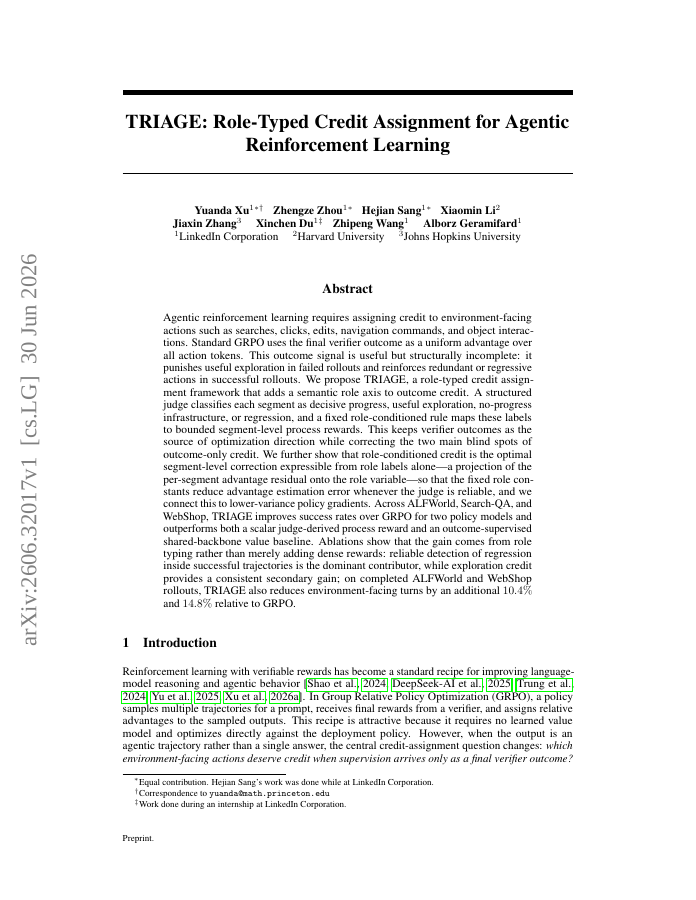
Agentic reinforcement learning requires assigning credit to environment-facing actions such as searches, clicks, edits, navigation commands, and object interactions. Standard GRPO uses the final verifier outcome as a uniform advantage over all action tokens. This outcome signal is useful but structurally incomplete: it punishes useful exploration in failed rollouts and reinforces redundant or regressive actions in successful rollouts. We propose TRIAGE, a role-typed credit assignment framework that adds a semantic role axis to outcome credit. A structured judge classifies each segment as decisive progress, useful exploration, no-progress infrastructure, or regression, and a fixed role-conditioned rule maps these labels to bounded segment-level process rewards. This keeps verifier outcomes as the source of optimization direction while correcting the two main blind spots of outcome-only credit. We further show that role-conditioned credit is the optimal segment-level correction expressible from role labels alone -- a projection of the per-segment advantage residual onto the role variable -- so that the fixed role constants reduce advantage estimation error whenever the judge is reliable, and we connect this to lower-variance policy gradients. Across ALFWorld, Search-QA, and WebShop, TRIAGE improves success rates over GRPO for two policy models and outperforms both a scalar judge-derived process reward and an outcome-supervised shared-backbone value baseline. Ablations show that the gain comes from role typing rather than merely adding dense rewards: reliable detection of regression inside successful trajectories is the dominant contributor, while exploration credit provides a consistent secondary gain; on completed ALFWorld and WebShop rollouts, TRIAGE also reduces environment-facing turns by an additional 10.4% and 14.8% relative to GRPO.
TRIAGE: Role-Typed Credit Assignment for Agentic Reinforcement Learning
Agentic reinforcement learning requires assigning credit to environment-facing actions such as searches, clicks, edits, navigation commands, and object interactions. Standard GRPO uses the final verifier outcome as a uniform advantage over all action tokens.
- Preview
- Year
- 2026
- Hosting
- Full text hostedCC-BY-4.0
Cite
Notes
Only stored in your browser.
Attribution
- Abstract & full text
- arxiv.org/abs/2606.32017CC-BY-4.0
- TL;DR
- Semantic Scholar