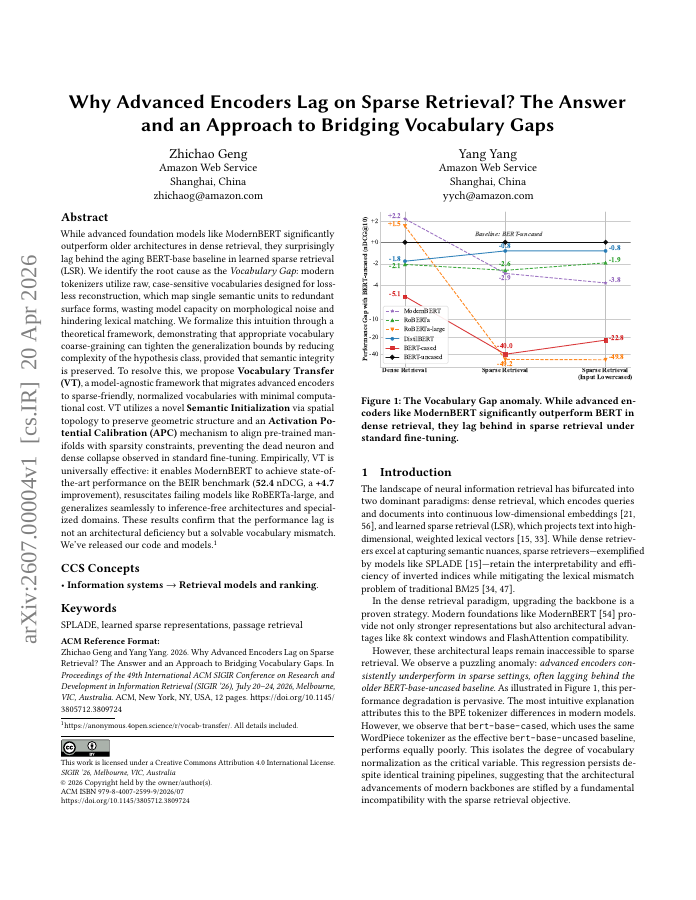
While advanced foundation models like ModernBERT significantly outperform older architectures in dense retrieval, they surprisingly lag behind the aging BERT-base baseline in learned sparse retrieval (LSR). We identify the root cause as the Vocabulary Gap: modern tokenizers utilize raw, case-sensitive vocabularies designed for lossless reconstruction, which map single semantic units to redundant surface forms, wasting model capacity on morphological noise and hindering lexical matching. We formalize this intuition through a theoretical framework, demonstrating that appropriate vocabulary coarse-graining can tighten the generalization bounds by reducing complexity of the hypothesis class, provided that semantic integrity is preserved. To resolve this, we propose Vocabulary Transfer (VT), a model-agnostic framework that migrates advanced encoders to sparse-friendly, normalized vocabularies with minimal computational cost. VT utilizes a novel Semantic Initialization via spatial topology to preserve geometric structure and an Activation Potential Calibration (APC) mechanism to align pre-trained manifolds with sparsity constraints, preventing the dead neuron and dense collapse observed in standard fine-tuning. Empirically, VT is universally effective: it enables ModernBERT to achieve state-of-the-art performance on the BEIR benchmark (52.4 nDCG, a +4.7 improvement), resuscitates failing models like RoBERTa-large, and generalizes seamlessly to inference-free architectures and specialized domains. These results confirm that the performance lag is not an architectural deficiency but a solvable vocabulary mismatch. We've released our code and models.\footnote{https://anonymous.4open.science/r/vocab-transfer/. All details included.}
Why Advanced Encoders Lag on Sparse Retrieval? The Answer and an Approach to Bridging Vocabulary Gaps
While advanced foundation models like ModernBERT significantly outperform older architectures in dense retrieval, they surprisingly lag behind the aging BERT-base baseline in learned sparse retrieval (LSR).
- Preview
- Year
- 2026
- Hosting
- Full text hostedCC-BY-4.0
Cite
Notes
Only stored in your browser.
Attribution
- Abstract & full text
- arxiv.org/abs/2607.00004CC-BY-4.0
- TL;DR
- Semantic Scholar