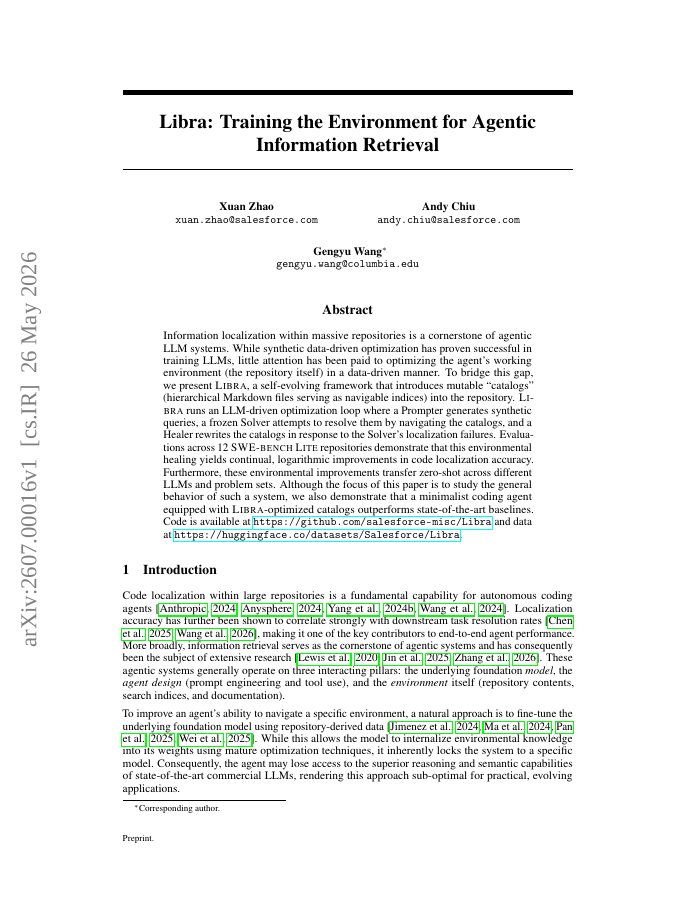
Information localization within massive repositories is a cornerstone of agentic LLM systems. While synthetic data-driven optimization has proven successful in training LLMs, little attention has been paid to optimizing the agent's working environment (the repository itself) in a data-driven manner. To bridge this gap, we present Libra, a self-evolving framework that introduces mutable "catalogs" (hierarchical Markdown files serving as navigable indices) into the repository. Libra runs an LLM-driven optimization loop where a Prompter generates synthetic queries, a frozen Solver attempts to resolve them by navigating the catalogs, and a Healer rewrites the catalogs in response to the Solver's localization failures. Evaluations across 12 SWE-bench Lite repositories demonstrate that this environmental healing yields continual, logarithmic improvements in code localization accuracy. Furthermore, these environmental improvements transfer zero-shot across different LLMs and problem sets. Although the focus of this paper is to study the general behavior of such a system, we also demonstrate that a minimalist coding agent equipped with Libra-optimized catalogs outperforms state-of-the-art baselines. Code is available at https://github.com/salesforce-misc/Libra and data at https://huggingface.co/datasets/Salesforce/Libra.
Libra: Training the Environment for Agentic Information Retrieval
Information localization within massive repositories is a cornerstone of agentic LLM systems. While synthetic data-driven optimization has proven successful in training LLMs, little attention has been paid to optimizing the agent's working environment (the repository itself) in…
- Preview
- Year
- 2026
- Hosting
- Full text hostedCC-BY-4.0
Cite
Notes
Only stored in your browser.
Attribution
- Abstract & full text
- arxiv.org/abs/2607.00016CC-BY-4.0
- TL;DR
- Semantic Scholar