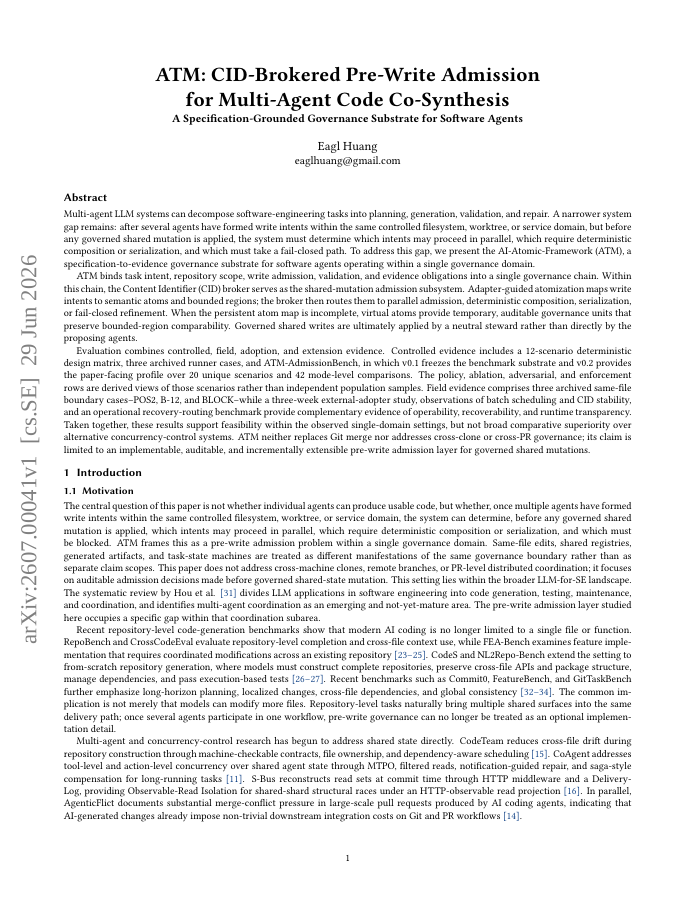
Multi-agent LLM systems can decompose software-engineering work into planning, generation, validation, and repair, but a narrower systems problem remains: before any governed shared mutation is applied, a system must decide which concurrently formed write intents may proceed in parallel, which require deterministic composition or serialization, and which must take a fail-closed path. We address this problem with the AI-Atomic-Framework (ATM), a specification-grounded governance substrate for software agents operating within a single governance domain. ATM binds task intent, repository scope, write admission, validation, and evidence obligations into one governance chain. A Content Identifier (CID) broker serves as the shared-mutation admission subsystem. Adapter-guided atomization maps write intents to semantic atoms and bounded regions; when persistent atom-map coverage is incomplete, virtual atoms provide temporary auditable governance units for conservative comparison and routing. Governed shared writes are ultimately applied by a neutral steward rather than directly by proposing agents. Evaluation combines controlled, field, adoption, and extension evidence, including a 12-scenario deterministic design matrix, three archived runner cases, ATM-AdmissionBench, three archived same-file boundary cases, a three-week external-adopter study, and an operational recovery-routing benchmark. The results support feasibility, auditability, and bounded recoverability within the observed single-domain settings, but do not claim broad comparative superiority or cross-clone governance.
ATM: CID-Brokered Pre-Write Admission for Multi-Agent Code Co-Synthesis
Multi-agent LLM systems can decompose software-engineering work into planning, generation, validation, and repair, but a narrower systems problem remains: before any governed shared mutation is applied, a system must decide which concurrently formed write intents may proceed in…
- Preview
- Year
- 2026
- Hosting
- Full text hostedCC-BY-4.0
Cite
Notes
Only stored in your browser.
Attribution
- Abstract & full text
- arxiv.org/abs/2607.00041CC-BY-4.0
- TL;DR
- Semantic Scholar