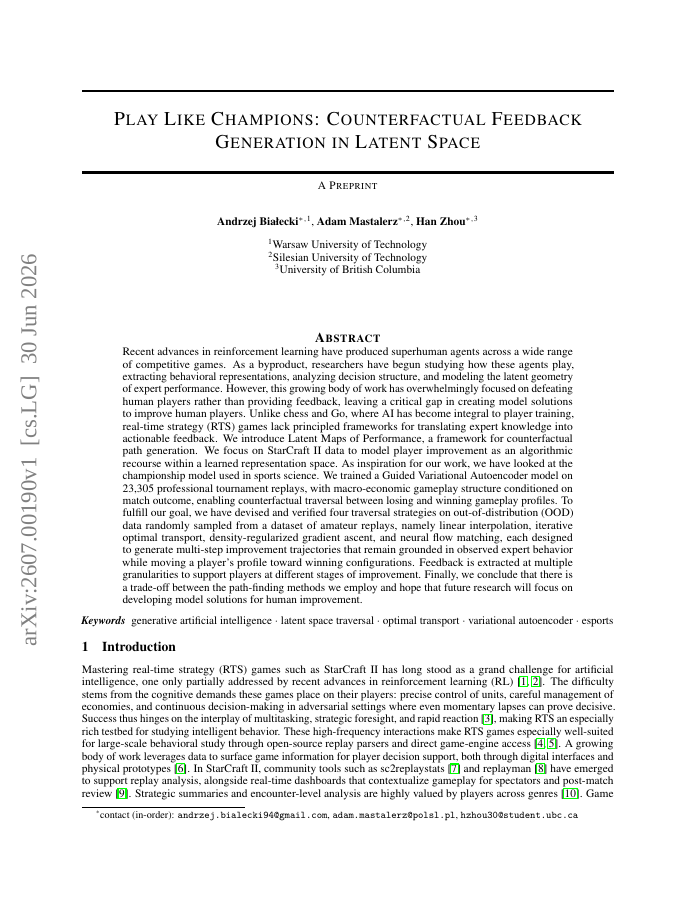
Recent advances in reinforcement learning have produced superhuman agents across a wide range of competitive games. As a byproduct, researchers have begun studying how these agents play, extracting behavioral representations, analyzing decision structure, and modeling the latent geometry of expert performance. However, this growing body of work has overwhelmingly focused on defeating human players rather than providing feedback, leaving a critical gap in creating model solutions to improve human players. Unlike chess and Go, where AI has become integral to player training, real-time strategy (RTS) games lack principled frameworks for translating expert knowledge into actionable feedback. We introduce Latent Maps of Performance, a framework for counterfactual path generation. We focus on StarCraft II data to model player improvement as an algorithmic recourse within a learned representation space. As inspiration for our work, we have looked at the championship model used in sports science. We trained a Guided Variational Autoencoder model on 23,305 professional tournament replays, enabling counterfactual traversal between losing and winning gameplay profiles. To fulfill our goal, we have devised and verified four traversal strategies on out-of-distribution (OOD) data randomly sampled from a dataset of amateur replays, namely linear interpolation, iterative optimal transport, density-regularized gradient ascent, and neural flow matching, each designed to generate multi-step improvement trajectories that remain grounded in observed expert behavior while moving a player's profile toward winning configurations. Feedback is extracted at multiple granularities to support players at different stages of improvement. Finally, we conclude that there is a trade-off between the path-finding methods we employ and hope that future research will focus on developing model solutions for human improvement.
Play Like Champions: Counterfactual Feedback Generation in Latent Space
Recent advances in reinforcement learning have produced superhuman agents across a wide range of competitive games. As a byproduct, researchers have begun studying how these agents play, extracting behavioral representations, analyzing decision structure, and modeling the latent…
- Preview
- Year
- 2026
- Hosting
- Full text hostedCC-BY-4.0
Cite
Notes
Only stored in your browser.
Attribution
- Abstract & full text
- arxiv.org/abs/2607.00190CC-BY-4.0
- TL;DR
- Semantic Scholar