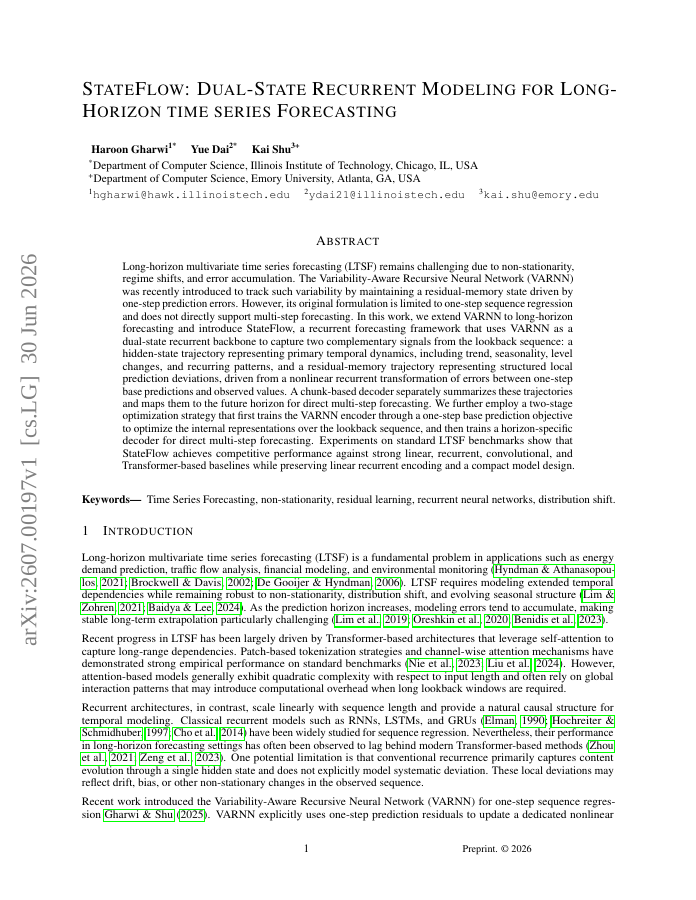
Long-horizon multivariate time series forecasting (LTSF) remains challenging due to non-stationarity, regime shifts, and error accumulation. The Variability-Aware Recursive Neural Network (VARNN) is designed to track such variability by maintaining a residual-memory state driven by one-step prediction errors. However, its original formulation is limited to one-step sequence regression and does not directly support multi-step forecasting. In this work, we extend VARNN to long-horizon forecasting and introduce StateFlow, a recurrent forecasting framework that uses VARNN as a dual-state recurrent backbone to capture two complementary signals from the lookback sequence: a hidden-state trajectory representing primary temporal dynamics, including trend, seasonality, level changes, and recurring patterns, and a residual-memory trajectory representing structured local prediction deviations, driven from a nonlinear recurrent transformation of errors between one-step base predictions and observed values. A chunk-based decoder separately summarizes these trajectories and maps them to the future horizon for direct multi-step forecasting. We further employ a two-stage optimization strategy that first trains the VARNN encoder through a one-step base prediction objective to optimize the internal representations over the lookback sequence, and then trains a horizon-specific decoder for direct multi-step forecasting. Experiments on standard LTSF benchmarks show that StateFlow achieves competitive performance against strong linear, recurrent, convolutional, and Transformer-based baselines while preserving linear recurrent encoding and a compact model design.
StateFlow: Dual-State Recurrent Modeling for Long-Horizon Time Series Forecasting
Long-horizon multivariate time series forecasting (LTSF) remains challenging due to non-stationarity, regime shifts, and error accumulation. The Variability-Aware Recursive Neural Network (VARNN) is designed to track such variability by maintaining a residual-memory state driven…
- Preview
- Year
- 2026
- Hosting
- Full text hostedCC-BY-4.0
Cite
Notes
Only stored in your browser.
Attribution
- Abstract & full text
- arxiv.org/abs/2607.00197CC-BY-4.0
- TL;DR
- Semantic Scholar