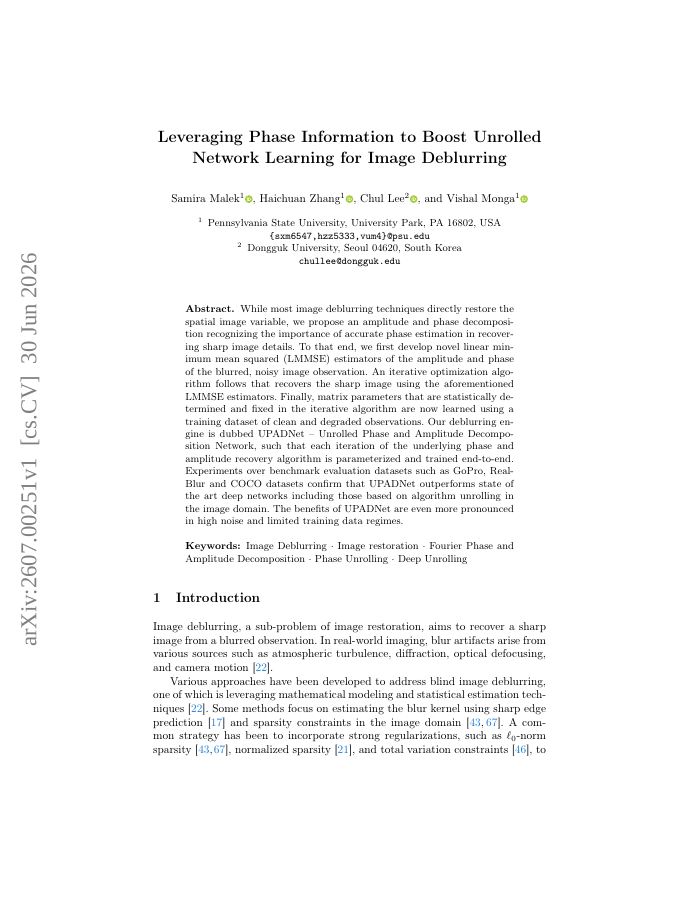
While most image deblurring techniques directly restore the spatial image variable, we propose an amplitude and phase decomposition recognizing the importance of accurate phase estimation in recovering sharp image details. To that end, we first develop novel linear minimum mean squared (LMMSE) estimators of the amplitude and phase of the blurred, noisy image observation. An iterative optimization algorithm follows that recovers the sharp image using the aforementioned LMMSE estimators. Finally, matrix parameters that are statistically determined and fixed in the iterative algorithm are now learned using a training dataset of clean and degraded observations. Our deblurring engine is dubbed UPADNet (Unrolled Phase and Amplitude Decomposition Network), such that each iteration of the underlying phase and amplitude recovery algorithm is parameterized and trained end-to-end. Experiments over benchmark evaluation datasets such as GoPro, RealBlur and COCO datasets confirm that UPADNet outperforms state of the art deep networks including those based on algorithm unrolling in the image domain. The benefits of UPADNet are even more pronounced in high noise and limited training data regimes.
Leveraging Phase Information to Boost Unrolled Network Learning for Image Deblurring
While most image deblurring techniques directly restore the spatial image variable, we propose an amplitude and phase decomposition recognizing the importance of accurate phase estimation in recovering sharp image details.
- Preview
- Year
- 2026
- Hosting
- Full text hostedCC-BY-4.0
Cite
Notes
Only stored in your browser.
Attribution
- Abstract & full text
- arxiv.org/abs/2607.00251CC-BY-4.0
- TL;DR
- Semantic Scholar