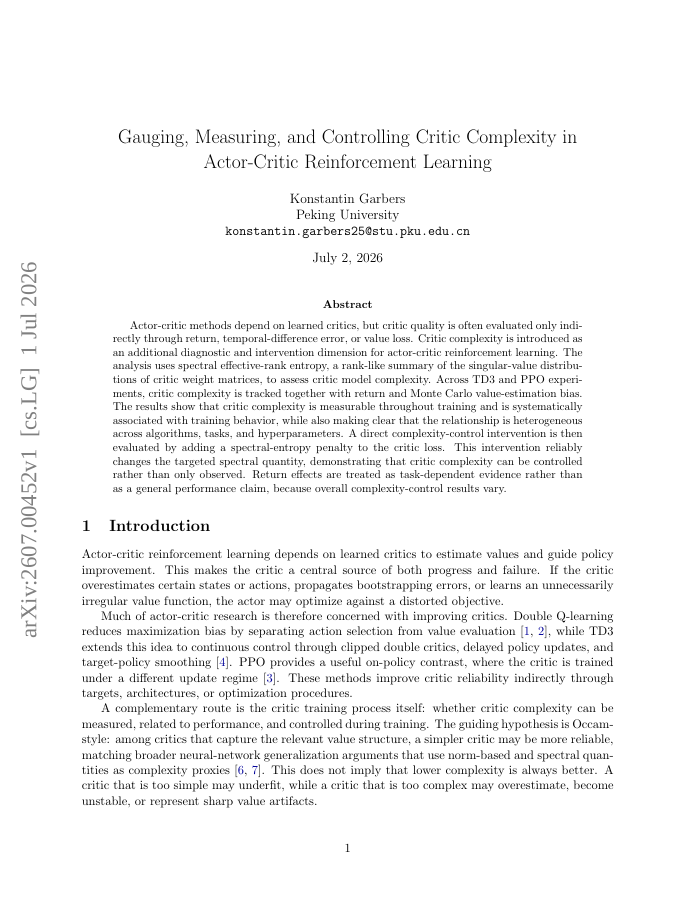
Actor-critic methods depend on learned critics, but critic quality is often evaluated only indirectly through return, temporal-difference error, or value loss. Critic complexity is introduced as an additional diagnostic and intervention dimension for actor-critic reinforcement learning. The analysis uses spectral effective-rank entropy, a rank-like summary of the singular-value distributions of critic weight matrices, to assess critic model complexity. Across TD3 and PPO experiments, critic complexity is tracked together with return and Monte Carlo value-estimation bias. The results show that critic complexity is measurable throughout training and is systematically associated with training behavior, while also making clear that the relationship is heterogeneous across algorithms, tasks, and hyperparameters. A direct complexity-control intervention is then evaluated by adding a spectral-entropy penalty to the critic loss. This intervention reliably changes the targeted spectral quantity, demonstrating that critic complexity can be controlled rather than only observed. Return effects are treated as task-dependent evidence rather than as a general performance claim, because overall complexity-control results vary.
Gauging, Measuring, and Controlling Critic Complexity in Actor-Critic Reinforcement Learning
Actor-critic methods depend on learned critics, but critic quality is often evaluated only indirectly through return, temporal-difference error, or value loss. Critic complexity is introduced as an additional diagnostic and intervention dimension for actor-critic reinforcement…
- Preview
- Year
- 2026
- Hosting
- Abstract onlyARXIV-DEFAULT
Cite
Notes
Only stored in your browser.
Attribution
- Abstract & full text
- arxiv.org/abs/2607.00452ARXIV-DEFAULT
- TL;DR
- Semantic Scholar