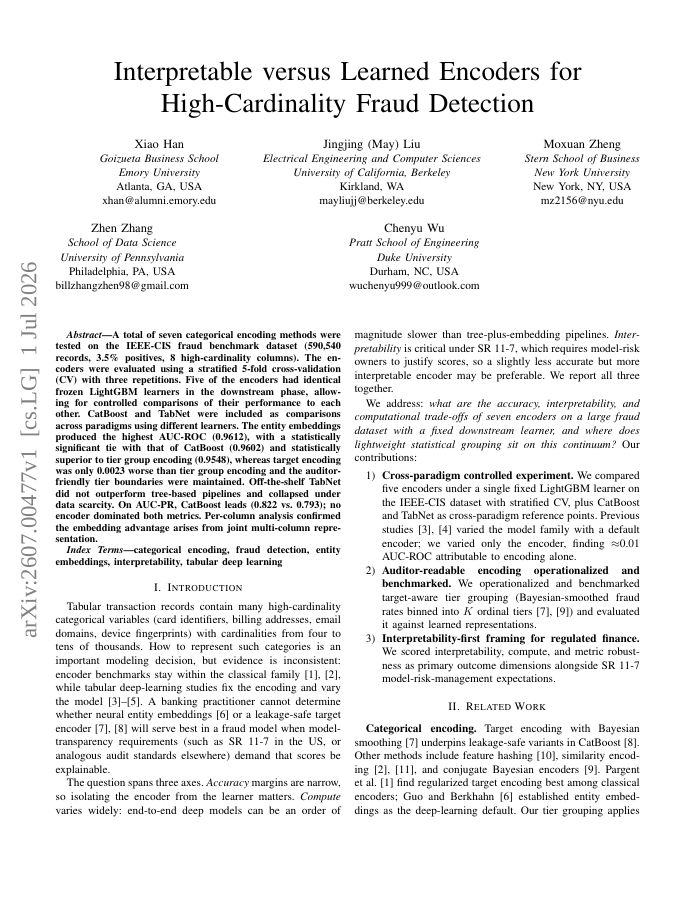
A total of seven categorical encoding methods were tested on the IEEE-CIS fraud benchmark dataset (590,540 records, 3.5% positives, 8 high-cardinality columns). The encoders were evaluated using a stratified 5-fold cross-validation (CV) with three repetitions. Five of the encoders had identical frozen LightGBM learners in the downstream phase, allowing for controlled comparisons of their performance to each other. CatBoost and TabNet were included as comparisons across paradigms using different learners. The entity embeddings produced the highest AUC-ROC (0.9612), with a statistically significant tie with that of CatBoost (0.9602) and statistically superior to tier group encoding (0.9548), whereas target encoding was only 0.0023 worse than tier group encoding and the auditor-friendly tier boundaries were maintained. Off-the-shelf TabNet did not outperform tree-based pipelines and collapsed under data scarcity. On AUC-PR, CatBoost leads (0.822 vs. 0.793); no encoder dominated both metrics. Per-column analysis confirmed the embedding advantage arises from joint multi-column representation.
Interpretable vs Learned Encoders for High-Cardinality Fraud Detection
A total of seven categorical encoding methods were tested on the IEEE-CIS fraud benchmark dataset (590,540 records, 3.5% positives, 8 high-cardinality columns). The encoders were evaluated using a stratified 5-fold cross-validation (CV) with three repetitions.
- Preview
- Year
- 2026
- Hosting
- Full text hostedCC-BY-4.0
Cite
Notes
Only stored in your browser.
Attribution
- Abstract & full text
- arxiv.org/abs/2607.00477CC-BY-4.0
- TL;DR
- Semantic Scholar