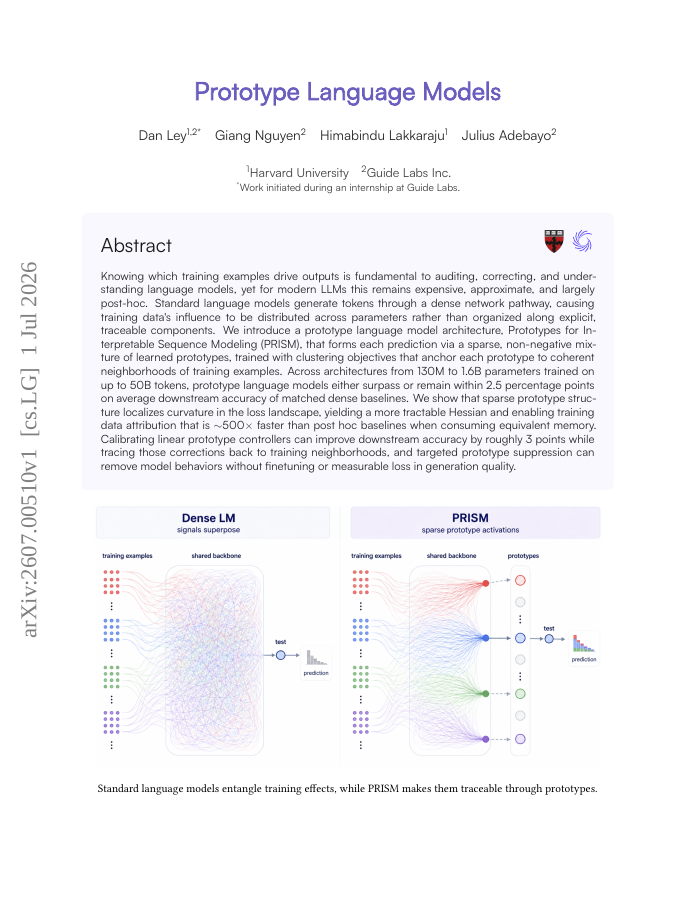
Knowing which training examples drive outputs is fundamental to auditing, correcting, and understanding language models, yet for modern LLMs this remains expensive, approximate, and largely post-hoc. Standard language models generate tokens through a dense network pathway, causing training data's influence to be distributed across parameters rather than organized along explicit, traceable components. We introduce a prototype language model architecture, Prototypes for Interpretable Sequence Modeling (PRISM), that forms each prediction via a sparse, non-negative mixture of learned prototypes, trained with clustering objectives that anchor each prototype to coherent neighborhoods of training examples. Across architectures from 130M to 1.6B parameters trained on up to 50B tokens, prototype language models either surpass or remain within 2.5 percentage points on average downstream accuracy of matched dense baselines. We show that sparse prototype structure localizes curvature in the loss landscape, yielding a more tractable Hessian and enabling training data attribution that is 500x faster than post hoc baselines when consuming equivalent memory. Calibrating linear prototype controllers can improve downstream accuracy by roughly 3 points while tracing those corrections back to training neighborhoods, and targeted prototype suppression can remove model behaviors without finetuning or measurable loss in generation quality.
Prototype Language Models
Knowing which training examples drive outputs is fundamental to auditing, correcting, and understanding language models, yet for modern LLMs this remains expensive, approximate, and largely post-hoc.
- Preview
- Year
- 2026
- Hosting
- Full text hostedCC-BY-4.0
Cite
Notes
Only stored in your browser.
Attribution
- Abstract & full text
- arxiv.org/abs/2607.00510CC-BY-4.0
- TL;DR
- Semantic Scholar