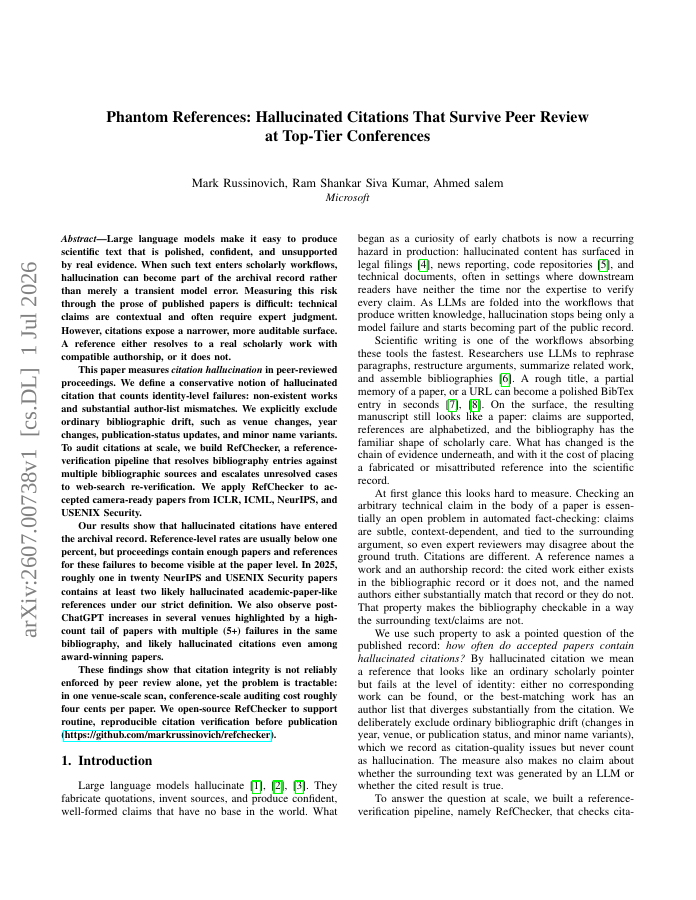
Large language models can generate polished scientific text that includes unsupported claims, allowing hallucinations to enter the archival record. Assessing this risk via technical statements is difficult and often requires expert judgment, but citations provide a more auditable surface: a reference either resolves to a real scholarly work with compatible authorship, or it does not. We measure citation hallucination in peer-reviewed proceedings using a conservative definition limited to identity-level failures: non-existent works and substantial author-list mismatches. We explicitly exclude ordinary bibliographic drift (e.g., venue/year differences, publication-status updates, minor name variants). To audit citations at scale, we build RefChecker, a verification pipeline that resolves bibliography entries against multiple bibliographic sources and escalates unresolved cases to web-search re-verification. We apply RefChecker to accepted camera-ready papers from ICLR, ICML, NeurIPS, and USENIX Security. Hallucinated citations have entered the archival record. While reference-level rates are usually below 1%, proceedings are large enough that paper-level failures are visible: in 2025, roughly one in twenty NeurIPS and USENIX Security papers contains at least two likely hallucinated academic-paper-like references under our strict definition. We also observe post-ChatGPT increases in several venues, including a tail of papers with 5+ failures in a single bibliography, and likely hallucinated citations even among award-winning papers. These results suggest peer review alone does not reliably enforce citation integrity, yet auditing is tractable (about 0.04$ per paper in one venue-scale scan). We open-source RefChecker for routine, reproducible citation verification before publication (https://github.com/markrussinovich/refchecker).
Phantom References: Hallucinated Citations That Survive Peer Review at Top-Tier Conferences
Large language models can generate polished scientific text that includes unsupported claims, allowing hallucinations to enter the archival record. Assessing this risk via technical statements is difficult and often requires expert judgment, but citations provide a more…
- Preview
- Year
- 2026
- Hosting
- Excerpt onlyCC-BY-NC-4.0
Cite
Notes
Only stored in your browser.
Attribution
- Abstract & full text
- arxiv.org/abs/2607.00738CC-BY-NC-4.0
- TL;DR
- Semantic Scholar