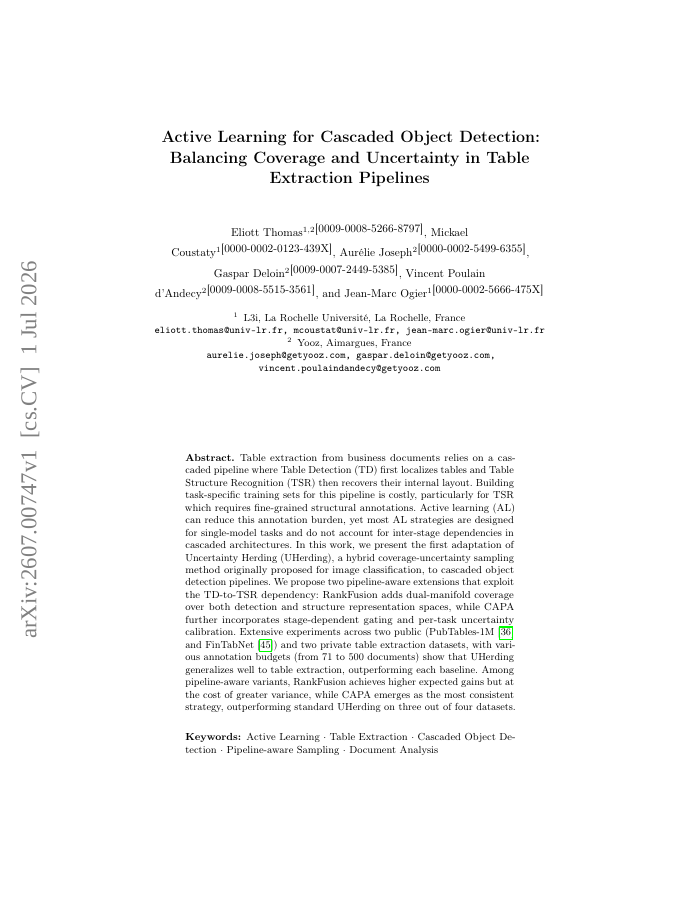
Table extraction from business documents relies on a cascaded pipeline where Table Detection (TD) first localizes tables and Table Structure Recognition (TSR) then recovers their internal layout. Building task-specific training sets for this pipeline is costly, particularly for TSR which requires fine-grained structural annotations. Active learning (AL) can reduce this annotation burden, yet most AL strategies are designed for single-model tasks and do not account for inter-stage dependencies in cascaded architectures. In this work, we present the first adaptation of Uncertainty Herding (UHerding), a hybrid coverage-uncertainty sampling method originally proposed for image classification, to cascaded object detection pipelines. We propose two pipeline-aware extensions that exploit the TD-to-TSR dependency: RankFusion adds dual-manifold coverage over both detection and structure representation spaces, while CAPA further incorporates stage-dependent gating and per-task uncertainty calibration. Extensive experiments across two public (PubTables-1M and FinTabNet) and two private table extraction datasets, with various annotation budgets (from 71 to 500 documents) show that UHerding generalizes well to table extraction, outperforming each baseline. Among pipeline-aware variants, RankFusion achieves higher expected gains but at the cost of greater variance, while CAPA emerges as the most consistent strategy, outperforming standard UHerding on three out of four datasets.
Active Learning for Cascaded Object Detection: Balancing Coverage and Uncertainty in Table Extraction Pipelines
Table extraction from business documents relies on a cascaded pipeline where Table Detection (TD) first localizes tables and Table Structure Recognition (TSR) then recovers their internal layout.
- Preview
- Year
- 2026
- Hosting
- Full text hostedCC-BY-4.0
Cite
Notes
Only stored in your browser.
Attribution
- Abstract & full text
- arxiv.org/abs/2607.00747CC-BY-4.0
- TL;DR
- Semantic Scholar