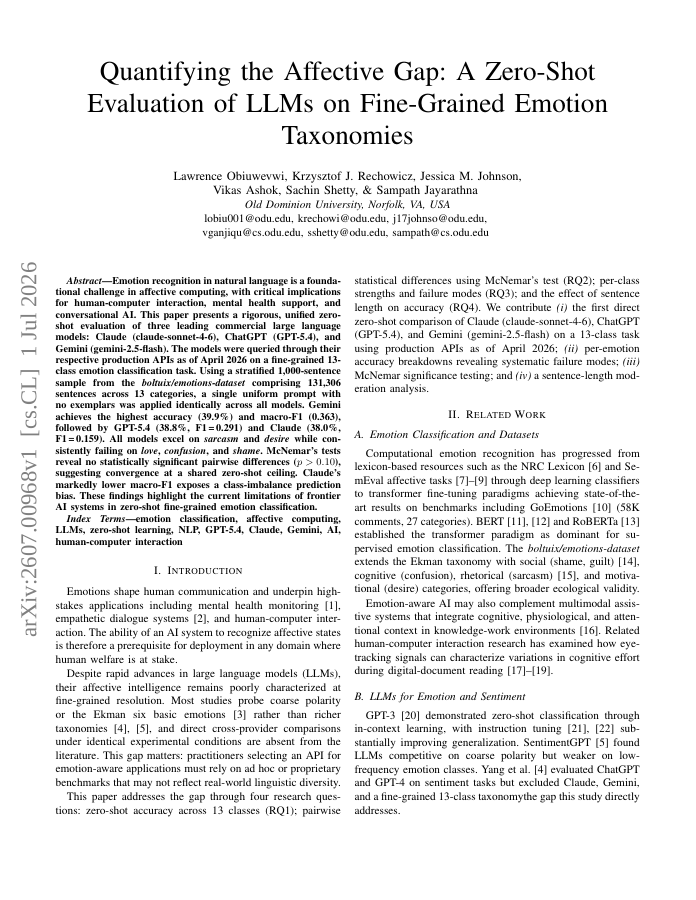
Emotion recognition in natural language is a foundational challenge in affective computing, with critical implications for human-computer interaction, mental health support, and conversational AI. This paper presents a rigorous, unified zero-shot evaluation of three leading commercial large language models: Claude (claude-sonnet-4-6), ChatGPT (GPT-5.4), and Gemini (gemini-2.5-flash). The models were queried through their respective production APIs as of April 2026 on a fine-grained 13-class emotion classification task. Using a stratified 1,000-sentence sample from the boltuix/emotions dataset, which comprises 131,306 sentences across 13 categories, a single uniform prompt with no exemplars was applied identically across all models. Gemini achieves the highest accuracy (39.9%) and macro-F1 score (0.363), followed by GPT-5.4 (38.8%, macro-F1 = 0.291) and Claude (38.0%, macro-F1 = 0.159). All models excel on sarcasm and desire while consistently failing on love, confusion, and shame. McNemar tests reveal no statistically significant pairwise differences (p > 0.10), suggesting convergence at a shared zero-shot ceiling. Claude's markedly lower macro-F1 score exposes a class-imbalance prediction bias. These findings highlight the current limitations of frontier AI systems in zero-shot fine-grained emotion classification.
Quantifying the Affective Gap: A Zero-Shot Evaluation of LLMs on Fine-Grained Emotion Taxonomies
Emotion recognition in natural language is a foundational challenge in affective computing, with critical implications for human-computer interaction, mental health support, and conversational AI.
- Preview
- Year
- 2026
- Hosting
- Excerpt onlyCC-BY-NC-SA-4.0
Cite
Notes
Only stored in your browser.
Attribution
- Abstract & full text
- arxiv.org/abs/2607.00968CC-BY-NC-SA-4.0
- TL;DR
- Semantic Scholar