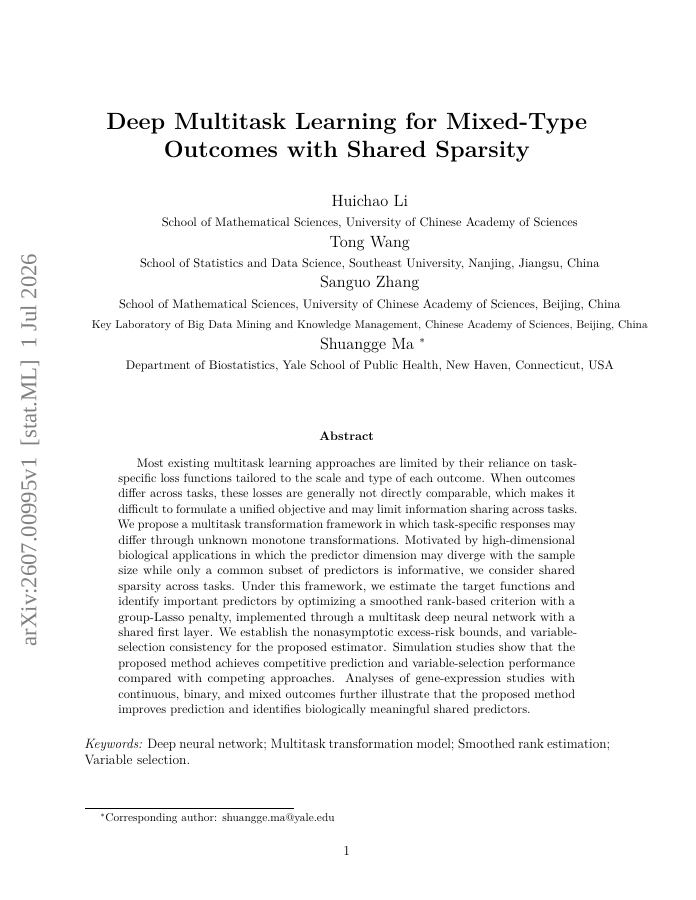
Most existing multitask learning approaches are limited by their reliance on task-specific loss functions tailored to the scale and type of each outcome. When outcomes differ across tasks, these losses are generally not directly comparable, which makes it difficult to formulate a unified objective and may limit information sharing across tasks. We propose a multitask transformation framework in which task-specific responses may differ through unknown monotone transformations. Motivated by high-dimensional biological applications in which the predictor dimension may diverge with the sample size while only a common subset of predictors is informative, we consider shared sparsity across tasks. Under this framework, we estimate the target functions and identify important predictors by optimizing a smoothed rank-based criterion with a group-Lasso penalty, implemented through a multitask deep neural network with a shared first layer. We establish the nonasymptotic excess-risk bounds, and variable-selection consistency for the proposed estimator. Simulation studies show that the proposed method achieves competitive prediction and variable-selection performance compared with competing approaches. Analyses of gene-expression studies with continuous, binary, and mixed outcomes further illustrate that the proposed method improves prediction and identifies biologically meaningful shared predictors.
Deep Multitask Learning for Mixed-Type Outcomes with Shared Sparsity
Most existing multitask learning approaches are limited by their reliance on task-specific loss functions tailored to the scale and type of each outcome. When outcomes differ across tasks, these losses are generally not directly comparable, which makes it difficult to formulate…
- Preview
- Year
- 2026
- Hosting
- Abstract onlyARXIV-DEFAULT
Cite
Notes
Only stored in your browser.
Attribution
- Abstract & full text
- arxiv.org/abs/2607.00995ARXIV-DEFAULT
- TL;DR
- Semantic Scholar