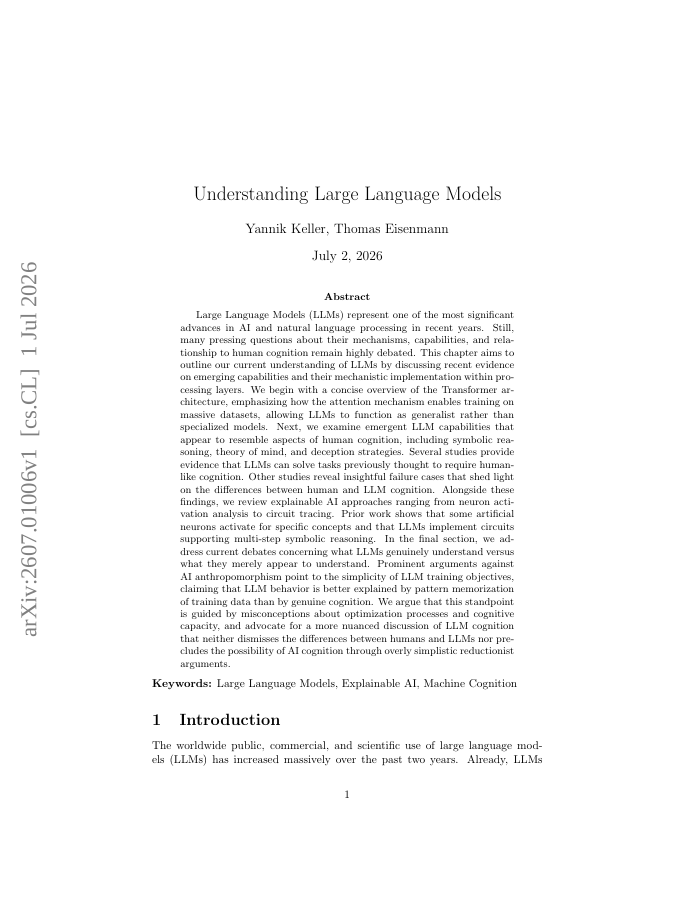
Large Language Models (LLMs) represent one of the most significant advances in AI and natural language processing in recent years. Still, many pressing questions about their mechanisms, capabilities, and relationship to human cognition remain highly debated. This chapter aims to outline our current understanding of LLMs by discussing recent evidence on emerging capabilities and their mechanistic implementation within processing layers. We begin with a concise overview of the Transformer architecture, emphasizing how the attention mechanism enables training on massive datasets, allowing LLMs to function as generalist rather than specialized models. Next, we examine emergent LLM capabilities that appear to resemble aspects of human cognition, including symbolic reasoning, theory of mind, and deception strategies. Several studies provide evidence that LLMs can solve tasks previously thought to require human-like cognition. Other studies reveal insightful failure cases that shed light on the differences between human and LLM cognition. Alongside these findings, we review explainable AI approaches ranging from neuron activation analysis to circuit tracing. In the final section, we address current debates concerning what LLMs genuinely understand versus what they merely appear to understand. Prominent arguments against AI anthropomorphism point to the simplicity of LLM training objectives, claiming that LLM behavior is better explained by pattern memorization of training data than by genuine cognition. We argue that this standpoint is guided by misconceptions about optimization processes and cognitive capacity, and advocate for a more nuanced discussion of LLM cognition that neither dismisses the differences between humans and LLMs nor precludes the possibility of AI cognition through overly simplistic reductionist arguments.
Understanding Large Language Models
Large Language Models (LLMs) represent one of the most significant advances in AI and natural language processing in recent years. Still, many pressing questions about their mechanisms, capabilities, and relationship to human cognition remain highly debated.
- Preview
- Year
- 2026
- Hosting
- Abstract onlyARXIV-DEFAULT
Cite
Notes
Only stored in your browser.
Attribution
- Abstract & full text
- arxiv.org/abs/2607.01006ARXIV-DEFAULT
- TL;DR
- Semantic Scholar