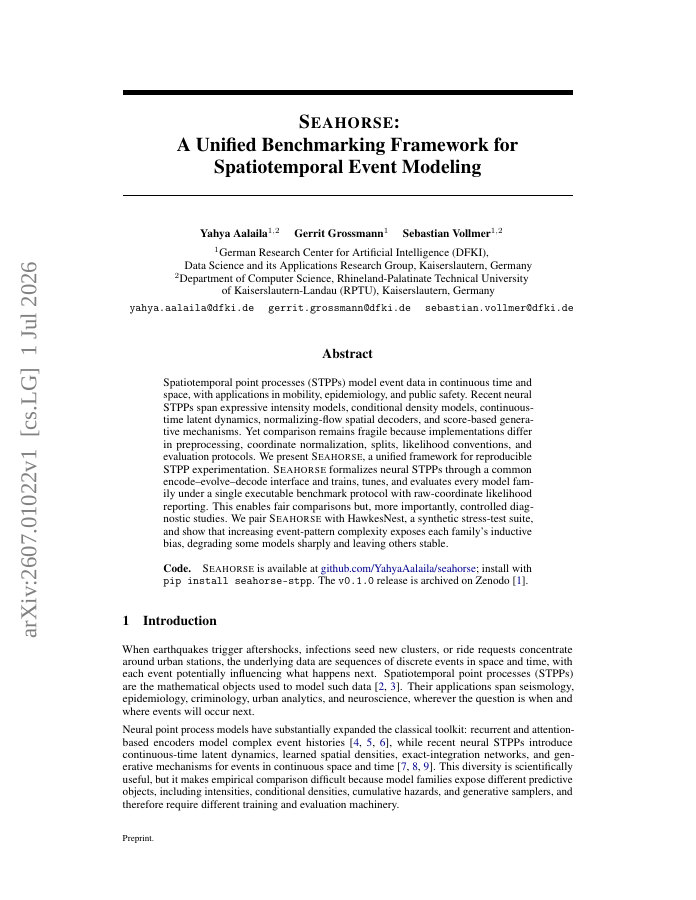
Spatiotemporal point processes (STPPs) model event data in continuous time and space, with applications in mobility, epidemiology, and public safety. Recent neural STPPs span expressive intensity models, conditional density models, continuous-time latent dynamics, normalizing-flow spatial decoders, and score-based generative mechanisms. Yet comparison remains fragile because implementations differ in preprocessing, coordinate normalization, splits, likelihood conventions, and evaluation protocols. We present SEAHORSE, a unified framework for reproducible STPP experimentation. SEAHORSE formalizes neural STPPs through a common encode-evolve-decode interface and trains, tunes, and evaluates every model family under a single executable benchmark protocol with raw-coordinate likelihood reporting. This enables fair comparisons but, more importantly, controlled diagnostic studies. We pair SEAHORSE with HawkesNest, a synthetic stress-test suite, and show that increasing event-pattern complexity exposes each family's inductive bias, degrading some models sharply and leaving others stable. Code: https://github.com/YahyaAalaila/seahorse.
Seahorse: A Unified Benchmarking Framework for Spatiotemporal Event Modeling
Spatiotemporal point processes (STPPs) model event data in continuous time and space, with applications in mobility, epidemiology, and public safety. Recent neural STPPs span expressive intensity models, conditional density models, continuous-time latent dynamics,…
- Preview
- Year
- 2026
- Hosting
- Abstract onlyARXIV-DEFAULT
Cite
Notes
Only stored in your browser.
Attribution
- Abstract & full text
- arxiv.org/abs/2607.01022ARXIV-DEFAULT
- TL;DR
- Semantic Scholar